Close your eyes for a second and imagine biting into a perfectly ripe mango. It’s sweet, juicy, and so fragrant that the smell alone makes your mouth water. Now imagine that the mango you’re eating is considered one of the finest in the entire world. That’s exactly what people experience when they taste a mango from Multan, the legendary fruit capital of Pakistan.
Multan, a city in the heart of Punjab province, has been famous for its mangoes for hundreds of years. Poets have written about them. Emperors have craved them. And today, people across Pakistan and around the world eagerly wait all year for mango season to arrive. But what exactly makes Multan’s mangoes so special? Is it the soil? The sunshine? The ancient farming traditions passed down through generations? The answer, it turns out, is all of the above.
In this article, we’re going on a delicious journey to discover why mango from Multan has earned such legendary status. You’ll learn about the city’s unique growing conditions, the most famous mango varieties, how farmers cultivate these golden fruits, and why they matter so much to Pakistan’s culture and economy. Let’s get into it!
Multan’s Secret Weapon: The Perfect Climate for Mangoes
Have you ever wondered why mangoes grow in some places but not others? It comes down to climate, and Multan happens to have almost exactly what mango trees love most. Multan is known for its intense heat, with summer temperatures regularly soaring above 45 degrees Celsius. For most crops, that would be a disaster. For mangoes, it’s paradise.
Mango trees thrive in hot, dry conditions during their flowering stage, and then need warm, humid weather as the fruit develops. Multan’s climate follows this pattern almost perfectly throughout the growing season. Think of it like a recipe: the city’s weather provides exactly the right ingredients, in exactly the right order, to produce fruit that’s sweeter and more flavorful than mangoes grown in cooler regions.
The soil in the Multan region also plays a huge role. The fertile plains of southern Punjab, nourished by the nearby Chenab and Sutlej rivers, are rich in nutrients that mango trees absorb over decades. Older mango trees in Multan have had generations to sink their roots deep into this rich soil, which is one reason why the fruit they produce tastes so remarkably different from mangoes grown elsewhere.
The Superstar Varieties: Multan’s Most Famous Mangoes
Not all mangoes are created equal, and Multan produces some of the most celebrated varieties in the world. Each one has its own personality, flavor profile, and fan base. Here are a few of the biggest stars:
- Chaunsa: Often called the queen of Pakistani mangoes, Chaunsa is Multan’s most famous variety. It’s incredibly sweet, almost honey-like, with a smooth, fiberless texture that practically melts in your mouth. Chaunsa is so popular that it’s exported to countries across the Middle East, Europe, and beyond.
- Sindhri: Sometimes called the “king of mangoes,” Sindhri is large, oval-shaped, and bursting with a rich, aromatic sweetness. Its golden-yellow skin and soft flesh make it one of the most visually stunning mangoes around.
- Anwar Ratol: Don’t let its small size fool you! Anwar Ratol is packed with intense, concentrated sweetness and a heavenly fragrance. Many mango lovers consider it the most flavorful variety of all, and it has a cult following among people who know their mangoes.
- Langra: Named after a legend, Langra mangoes have a distinctively tangy-sweet flavor that sets them apart. They’re greenish even when fully ripe, which surprises first-timers, but one bite and you’ll understand why they’ve been grown in this region for centuries.
Each of these varieties represents years, sometimes decades, of careful cultivation and selection by Multan’s dedicated farming community.
From Orchard to Your Hand: How Multan’s Mangoes Are Grown
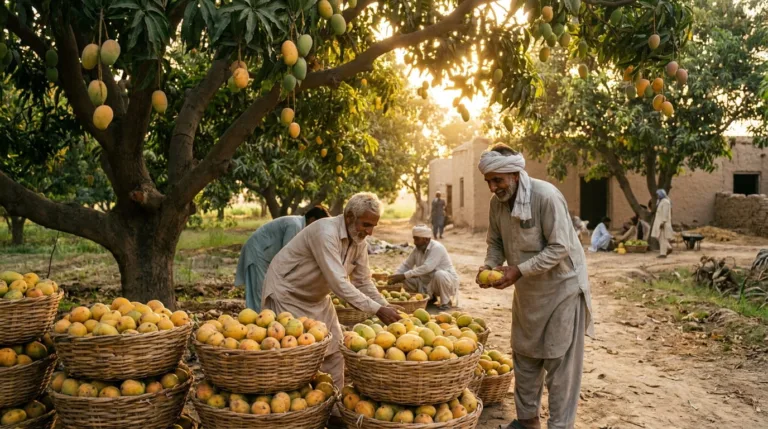
Growing a great mango isn’t as simple as planting a seed and waiting. It’s a year-round commitment that requires skill, patience, and a deep understanding of the land. Mango orchards in Multan are often family-owned, with trees that are decades, or even over a hundred years old. Those ancient trees are like the wise elders of the orchard, producing some of the most flavorful fruit imaginable.
The mango season in Multan typically runs from May to September, with different varieties ripening at different times. Farmers spend the entire year preparing for those crucial few months. During winter, they prune the trees and manage the soil. In spring, they monitor the flowering stage closely, because this is when the tiny flowers that eventually become mangoes first appear. A sudden storm or unexpected cold snap at this stage can damage the entire season’s crop.
Once the mangoes start developing, farmers keep a close eye on irrigation, making sure the trees get enough water without being overwatered. Harvesting is done carefully by hand to avoid bruising the delicate fruit. A bruised mango doesn’t just look bad, it ripens unevenly and loses its prized flavor, so every step of the process is handled with care. At Multanfarms.com, this tradition of careful, responsible cultivation is something that’s taken very seriously.
Mangoes and Culture: More Than Just a Fruit
In Multan, mangoes aren’t just food. They’re part of the city’s identity and culture. Mango festivals, locally known as “Mango Melas,” are a beloved summer tradition where families gather, farmers showcase their finest varieties, and visitors from across the country come to taste and celebrate the season. It’s like a music festival, but instead of bands, the stars are the mangoes!
Mangoes also have deep roots in South Asian history. Mughal Emperor Akbar reportedly had over 100,000 mango trees planted in his royal orchards. The mango is even mentioned in ancient Sanskrit texts dating back more than 4,000 years. When you eat a mango from Multan, you’re tasting something that kings, poets, and ordinary people have enjoyed for thousands of years. That’s a pretty incredible connection to history for a single fruit!
On a more practical level, the mango industry is a massive part of Multan’s economy. Pakistan is one of the top mango-exporting countries in the world, and Multan sits right at the center of that industry. Thousands of farming families, workers, traders, and exporters depend on mango season for their livelihoods. A single fruit feeds not just stomachs, but entire communities.
Pakistan’s Mango on the World Stage
Multan’s mangoes don’t just stay in Pakistan. They travel the world! Pakistani mangoes, especially the famous Chaunsa variety, are exported to the United Kingdom, the United Arab Emirates, Saudi Arabia, Canada, and many other countries. Pakistani communities living abroad often describe receiving a box of mangoes from home as one of the most exciting and nostalgic things imaginable. It’s a taste of home packed into a crate.
International buyers are increasingly recognizing what Pakistani mango lovers have always known: mango from Multan simply hits differently. The combination of climate, soil, traditional farming knowledge, and premium varieties produces fruit that’s hard to match anywhere else in the world.
The Sweetest Conclusion
From the blazing Multan sun to the careful hands of generations of farmers, every mango from Multan carries a story. It’s a story of perfect climate and ancient soil, of beloved varieties and proud farming traditions, and of a city that has built its identity around one of nature’s most delicious gifts.
The next time you bite into a sweet, juicy mango, take a moment to think about everything that went into producing that one fruit. The seasons, the soil, the years of knowledge, and the people who made it possible are all part of what you’re tasting. And if you ever get the chance to try a Chaunsa or an Anwar Ratol from Multan’s orchards, don’t hesitate for a second.
So here’s a question worth sitting with: if one city can become world-famous for perfecting a single fruit over centuries, what does that tell us about the power of tradition, patience, and genuine passion for what you do?