Have you ever cracked open a fresh egg and wondered what it actually took to get it to your breakfast plate? Behind every egg sits a layer chicken, a hardworking hen bred specifically to produce eggs day after day. But raising these birds is a business, and like any business, it comes with real costs that every farmer needs to understand before getting started.
Whether you’re thinking about starting a poultry farm or you’re already running one and want to sharpen your numbers, knowing the real costs behind layer chicken farming can be the difference between profit and loss. Let’s break it all down, from the first chick you buy to the last tray of eggs you sell.
What Exactly Is a Layer Chicken?
A layer chicken is a hen bred specifically for egg production, not for meat. Think of it like choosing a dairy cow instead of a beef cow. These birds can lay up to 300 eggs per year under the right conditions, which is what makes them so valuable to farmers across Pakistan.
Popular breeds like Lohmann Brown, Hy-Line, and ISA Brown are common choices because they produce eggs consistently and efficiently. A good layer hen starts laying around 18 to 20 weeks of age and keeps going through about 72 weeks of production. That’s a long productive window, and it’s exactly why the investment can be worth every rupee.
Setting Up: The One-Time Costs You Can’t Skip
Before you buy a single chick, you need a proper place to house them. Shed construction is usually the biggest upfront cost in layer farming. A basic shed for 1,000 birds in Pakistan can cost anywhere from Rs. 150,000 to Rs. 400,000, depending on materials, location, and ventilation setup.
Then comes the equipment. You’ll need drinkers, feeders, cages or floor systems, exhaust fans, and lighting systems. Altogether, equipment for a 1,000-bird flock can add another Rs. 100,000 to Rs. 200,000 to your starting bill. Think of this phase like setting up a classroom before students arrive, the room has to be ready before any real work can begin.
The Cost of the Birds Themselves
Now comes the exciting part, actually buying your chicks. A day-old layer chick in Pakistan typically costs between Rs. 100 and Rs. 180 depending on the breed and hatchery. For a starter flock of 1,000 birds, that’s Rs. 100,000 to Rs. 180,000 right at the beginning.
Here’s something many beginners overlook: those chicks don’t start laying right away. You’ll spend the first 18 to 20 weeks raising them as pullets, meaning you’re feeding and caring for them before you see a single egg. This pre-production period adds a significant extra layer of cost to your overall budget before any income arrives.
The Biggest Monthly Expense: Feed
This is where the bulk of your money goes, every single month. Feed accounts for roughly 65 to 70 percent of the total running cost of a layer farm. A laying hen eats about 115 to 120 grams of feed per day, and for 1,000 birds, that’s around 115 kilograms consumed daily.
Commercial layer feed in Pakistan currently ranges from Rs. 90 to Rs. 110 per kilogram depending on brand and ingredient quality. That means a flock of 1,000 birds can cost Rs. 10,000 to Rs. 12,500 per day in feed alone, or between Rs. 300,000 and Rs. 375,000 per month. This is exactly why experienced farmers obsess over feed conversion ratios and minimising waste at every stage.
Vaccination, Medicine, and Bird Health
Healthy hens lay more eggs, so cutting corners on health care is a costly mistake. A proper vaccination program covers diseases like Newcastle disease, Marek’s disease, Infectious Bronchitis, and Gumboro. Running a full vaccination schedule for 1,000 birds during the growing phase costs roughly Rs. 5,000 to Rs. 15,000.
Monthly vitamins, supplements, and routine medication for laying birds add another Rs. 3,000 to Rs. 8,000 per month to your expenses. Disease outbreaks can wipe out an entire flock in days, so treat health spending as insurance, not an optional extra. Prevention is always cheaper than the cost of losing your birds.
Labor, Electricity, and Day-to-Day Running Costs
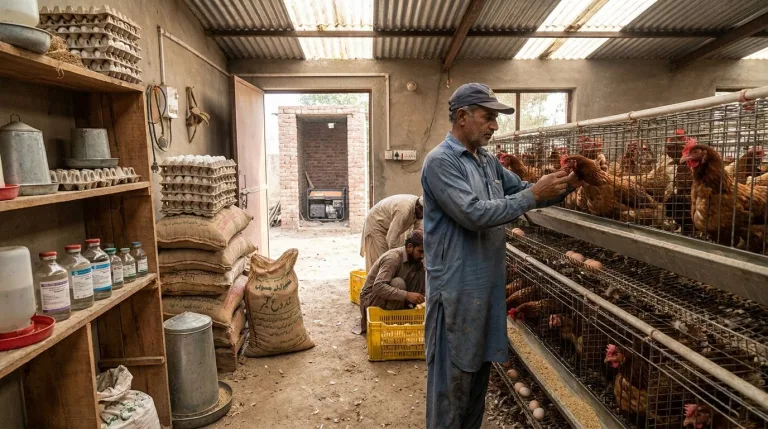
A flock of 1,000 birds needs consistent, hands-on daily care. You’ll typically need at least one full-time farm worker, with salaries ranging from Rs. 20,000 to Rs. 35,000 per month depending on experience and location. Add electricity costs for fans, lighting, and water pumps, which can run Rs. 8,000 to Rs. 15,000 per month depending on the season.
Smaller recurring costs include egg trays, litter material, cleaning supplies, and transport for selling your eggs. These miscellaneous expenses can add Rs. 10,000 to Rs. 20,000 per month to your books. Keep a written record of every expense, because small amounts compound into significant numbers faster than you’d expect.
Is Layer Farming Actually Profitable?
Here’s the real answer: yes, it can be, but margins depend on egg prices, feed costs, and how well you manage your flock. A flock of 1,000 hens at peak production typically delivers 850 to 900 eggs per day, assuming an 85 to 90 percent production rate. At current market prices of Rs. 15 to Rs. 20 per egg, that’s Rs. 12,750 to Rs. 18,000 in daily revenue.
Daily expenses including feed, labor, utilities, and medicine run between Rs. 12,000 and Rs. 15,000 for that same flock. The profit margin is real but tight, which is why scale matters. Farmers managing larger flocks spread their fixed costs across more birds and see better returns per egg, making a well-run farm of 5,000 birds significantly more profitable per bird than one running 500.
Practical Tips to Keep Your Costs Under Control
Smart layer farmers follow a few habits that protect their margins. Buy quality chicks from a reputable hatchery, because weak chicks mean poor production and higher mortality. Consider mixing your own feed using raw materials like maize, soya bean meal, and limestone, since a well-formulated homemade blend can cut feed costs by 20 to 30 percent.
Never skip your vaccination schedule, because disease prevention costs a fraction of what restocking does. Track your feed conversion ratio regularly and keep working to improve it. And whenever possible, sell eggs directly to local retailers or households to avoid losing margin to middlemen.
Start Your Layer Farm with the Right Knowledge
Layer chicken farming is a serious business with serious costs, but it’s also a business with consistent demand and real income potential. Understanding every rupee you’ll spend before you spend it is what separates a farm that struggles from one that grows steadily year after year.
Want more expert guidance on poultry farming, Pakistani agriculture, and natural farm products? Visit Multanfarms.com for practical advice, product insights, and resources that help your farm work smarter.