Imagine cracking open an egg so large it could feed a family of ten at one sitting. That’s not a scene from a fantasy story, it’s the reality of an ostrich egg, the largest egg laid by any living bird on earth today. If you’ve never encountered one in person, the sheer scale of it is genuinely hard to believe until you’re holding it.
Ostriches are fascinating creatures, and the eggs they produce reflect everything remarkable about the animal itself. Big, powerful, and packed with nutritional value, ostrich eggs have been eaten by humans for thousands of years across Africa and beyond. More recently, they’ve started attracting serious interest from food lovers, nutritionists, and farmers in South Asia, including Pakistan.
This guide covers everything worth knowing about ostrich eggs: how big they really are, what they contain nutritionally, how to cook with them, what they cost, and why ostrich farming is quietly becoming a growing enterprise in Pakistan.
Just How Big Is an Ostrich Egg?
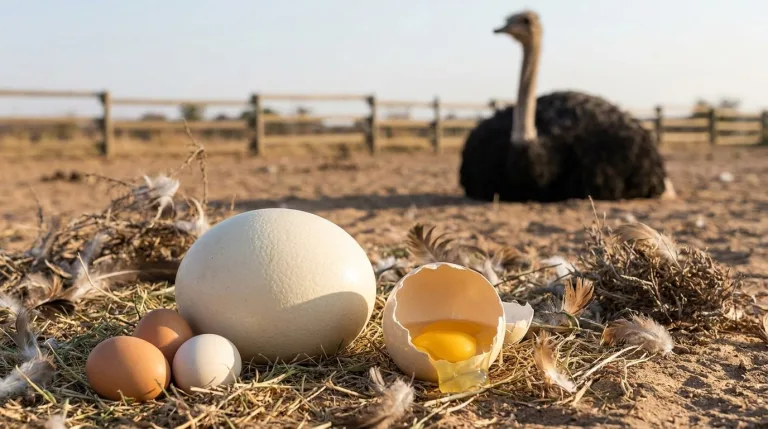
The numbers are genuinely staggering. A single ostrich egg weighs between 1.2 and 1.9 kilograms, making it roughly equivalent to 24 standard chicken eggs in volume. In terms of dimensions, it measures about 15 centimetres in length and 13 centimetres in width, somewhere close to the size of a small melon.
The shell itself is a feat of natural engineering. It’s about 2 millimetres thick and hard enough to support the weight of a full-grown adult standing on it without cracking. Ostrich farmers often need a saw or a hand drill to open one cleanly. Compare that to tapping a chicken egg against the rim of a bowl and you start to appreciate just how different these eggs are.
The yolk inside is proportionally large too, rich, deep yellow, and surrounded by a thick, gelatinous white. The overall composition is similar to a chicken egg but scaled up dramatically, which means cooking with one requires a completely different approach to timing and heat.
What Does an Ostrich Egg Contain Nutritionally?
Nutritionally, an ostrich egg is a concentrated source of high-quality protein and essential fats. A whole egg contains approximately 2,000 calories, 180 grams of protein, 130 grams of fat, and significant quantities of vitamins and minerals including B12, riboflavin, folate, and iron.
The protein in ostrich eggs is considered complete, meaning it contains all nine essential amino acids the body cannot produce on its own. This makes it comparable in quality to the protein found in chicken eggs, just delivered in a much larger package. The fat content is primarily made up of unsaturated fatty acids, which are generally considered the more beneficial type of dietary fat.
Like all egg yolks, the ostrich egg yolk is high in dietary cholesterol. For most healthy people this isn’t a concern in moderate consumption, but it’s worth keeping in mind if you’re sitting down to a substantial portion in one meal.
How Do You Actually Cook With an Ostrich Egg?
The first challenge is getting the egg open. You’ll need a hand drill, a small saw, or a heavy knife and some patience to break through that thick shell. Once you do, the egg behaves much like a very large chicken egg, just with considerably different cooking times.
Scrambled ostrich eggs are the most practical approach for home cooking. Because of the sheer volume involved, they take around 45 minutes to an hour in a large pan on medium-low heat to cook through properly. The result has a creamy, rich texture and a flavour that’s slightly more intense than chicken egg but still familiar and genuinely delicious.
Boiling a whole ostrich egg takes approximately 90 minutes for a fully hard-boiled result. Most people who cook with them regularly treat the egg as a large batch of raw egg mixture and portion it into smaller amounts for omelettes, baking, or quiche rather than attempting to cook it all in one go.
Are Ostrich Eggs Used in Pakistani Cooking?
Ostrich farming in Pakistan is still a relatively young industry, concentrated mainly in Punjab and Sindh. As a result, ostrich eggs in Pakistan are not yet a mainstream grocery item and are found primarily at specialist farms, exotic food markets in larger cities, and increasingly through online farm-to-table platforms.
In terms of cooking application, the flavour profile translates well into traditional Pakistani dishes. An ostrich egg works beautifully in a large-batch egg curry, a family-sized masala omelette loaded with green chillies and fresh coriander, or a rich custard-based dessert. The flavour adapts readily to bold spices without getting lost.
The shell, once emptied and cleaned, is also valued decoratively. Its hard surface takes paint and carving remarkably well, and artisans in some regions produce intricately decorated ostrich egg shells as display pieces and gifts.
What Does an Ostrich Egg Cost in Pakistan?
Ostrich eggs are significantly more expensive than chicken or quail eggs, and understandably so. Raising ostriches requires more land, more specialised feed, and more farming expertise than conventional poultry. A single ostrich hen also lays far fewer eggs per year, typically between 40 and 80, compared to the 250 to 300 a laying chicken produces annually.
In Pakistan, the price of a single fresh ostrich egg varies by source and availability but generally ranges between Rs 8,000 and Rs 15,000. For most buyers, it’s a special-occasion purchase rather than a weekly staple. The price is partly offset by what you’re getting, since one ostrich egg delivers the equivalent of roughly two dozen chicken eggs in a single purchase.
Why Is Interest in Ostrich Eggs Growing?
Interest in ostrich eggs is rising globally for several reasons. Health-conscious consumers are drawn to the high-quality protein and the appeal of an alternative egg source. Chefs and food enthusiasts value them for their impressive scale and rich flavour. And as ostrich farming expands in countries like Pakistan, availability is gradually improving.
Ostriches are also efficient converters of feed to protein, they require far less water than cattle, and their meat and eggs both contribute income to a single farming operation. As sustainable agriculture becomes a higher priority, ostrich farming is increasingly seen as a viable and forward-looking choice for farmers looking to diversify.
For growers in Multan and wider Punjab, the ostrich represents a real opportunity to move into a premium market that is still developing in Pakistan and carries strong potential for growth.
An Egg Worth Knowing About
Ostrich eggs occupy a unique space, too large and costly to be an everyday ingredient, but genuinely impressive in nutritional value, flavour, and culinary range. Whether you’re a food enthusiast curious about something different, a farmer exploring new income streams, or a cook looking for an extraordinary centrepiece for a special occasion, the ostrich egg is worth knowing about.
At Multanfarms.com, we connect you with authentic farm products sourced directly from Pakistani farms, including specialty items that reflect the full diversity of what this land produces. Explore our range and discover the genuine flavours of Pakistan’s farming heritage.