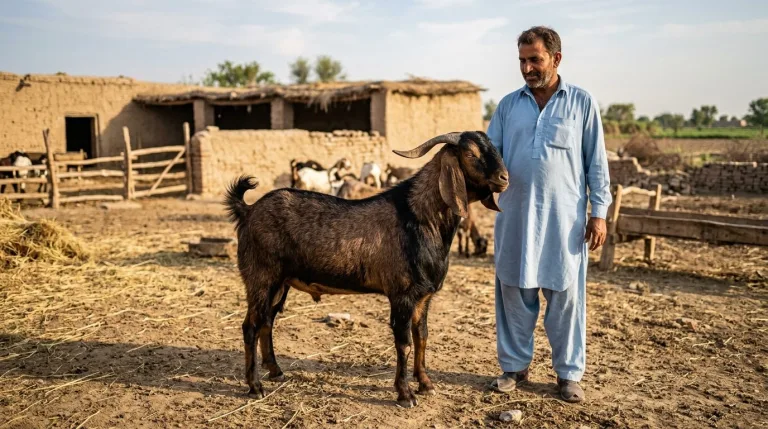
Pakistan sits among the top goat-producing countries in the world, and a big part of that story comes down to the remarkable variety of indigenous breeds spread across its provinces. Each breed carries the fingerprint of its homeland, shaped by climate, terrain, and generations of local farming knowledge. One breed that deserves far more recognition than it typically receives is the Dera Din Panah goat, a sturdy and commercially valuable livestock animal from the heart of South Punjab.
Named after the historic town of Dera Din Panah in Muzaffargarh district, this goat has been part of the region’s farming culture for generations. Muzaffargarh sits in the lower belt of Punjab, not far from Multan, sharing the same semi-arid climate that makes livestock rearing both challenging and rewarding. Farmers in this belt have long depended on this breed, and once you understand what it offers, it’s easy to see why.
A Breed Born From the Soil of South Punjab
To appreciate the Dera Din Panah goat, you need to picture the landscape it comes from. South Punjab is a region of sweeping open plains, intense summer heat, and a farming culture that has sustained entire communities for centuries. Rivers like the Chenab cut through the land, and agriculture has always been the backbone of local life. It’s in this environment that the Dera Din Panah goat gradually developed its defining traits.
Indigenous breeds are breeds that evolve naturally within a specific region over long periods of time, and this is exactly what the Dera Din Panah goat is. Local farmers selected the strongest, healthiest animals across successive generations, creating a goat that’s perfectly matched to its environment. That kind of natural adaptation cannot be replicated quickly or artificially. It’s the product of deep, lived experience between a community and its land.
The town of Dera Din Panah itself is historically significant in Muzaffargarh, and the goat carries that regional identity in its very name.
Physical Characteristics That Set It Apart
The Dera Din Panah goat is a medium to large-sized breed, immediately noticeable for its solid, muscular build. Compared to smaller local breeds, these goats carry noticeably more body mass, which directly translates into better meat yield at the time of sale. That’s a quality every livestock farmer watches for when selecting breeding stock.
Their coats are typically short and can appear in a range of colors, including shades of brown, black, white, and mixed patterns. Their legs are strong and well-structured, suited to moving across the mixed terrain of rural Punjab without issue. The overall impression is of an animal built for productivity, not just survival.
A healthy Dera Din Panah goat has visible muscle development across its back and hindquarters, the primary areas that yield quality cuts of meat. Experienced livestock traders can often identify the breed at a glance in the markets of Muzaffargarh and Multan.
Primary Use: Meat Production
The Dera Din Panah goat is first and foremost a meat breed, raised primarily to meet the consistent demand for mutton across Pakistan. Goat meat plays a central role in Pakistani food culture. From Eid-ul-Adha to wedding feasts and everyday cooking, dishes like mutton karahi, biryani, and sajji are central to how Pakistanis celebrate and feed their families.
Because of the breed’s larger frame and solid muscle development, it produces well-proportioned cuts that command strong prices in local livestock markets. For small and medium-scale farmers in South Punjab, this translates into meaningful income at selling time. A well-raised Dera Din Panah goat is a financial asset the whole household can rely on.
Some farmers also benefit from milk production as a secondary yield. While this breed isn’t specifically developed for dairy, goat milk is nutritious and finds use in households for traditional dairy products, helping offset feeding costs during the raising period.
Feeding and Day-to-Day Management
One of the biggest practical advantages of the Dera Din Panah goat is how manageable it is to raise. These are naturally hardy animals that thrive on locally available feed, keeping operational costs low for farmers working with limited resources.
During the day, goats are typically allowed to browse freely on available vegetation. Goats are natural browsers, meaning they prefer to nibble on shrubs, leaves, and varied plant matter rather than graze uniformly like cattle. At night, farmers bring the animals back to secure pens to protect them from predators and the elements.
Feeding is supplemented with agricultural by-products like wheat straw, dried corn husks, and crop residues, all of which are readily available on local farms. Basic veterinary care, including vaccinations and deworming, keeps the herd healthy and supports steady weight gain. When the basics are managed consistently, this breed responds well and rewards the farmer reliably.
Why Indigenous Breeds Like This One Matter
There’s a growing trend in commercial farming to replace indigenous breeds with imported or hybrid animals in pursuit of higher yields. While imported breeds have their place, indigenous breeds carry centuries of genetic adaptation that foreign breeds simply don’t possess. They tolerate local heat, resist local diseases more effectively, and thrive on locally sourced feed without needing expensive imported supplements.
The Dera Din Panah goat represents this value in concrete terms. It doesn’t need specialized facilities or high-cost nutrition programs. It has been surviving and producing in South Punjab’s conditions for generations, and that resilience is something worth actively protecting.
Beyond economics, breeds like the Dera Din Panah goat are part of Pakistan’s agricultural identity. They carry the accumulated knowledge of entire communities, and losing them to commercial replacement would mean losing something that cannot easily be recovered.
Quick Facts Worth Knowing
A few things that add useful context to this breed and the broader world of Pakistani goat farming:
- Pakistan is consistently ranked among the top five countries globally for goat population.
- The Dera Din Panah goat is recognized as a notable meat breed native to Punjab’s livestock belt.
- Goats have been domesticated for over 10,000 years, making them one of humanity’s oldest livestock companions.
- South Punjab, including Muzaffargarh, is one of the most active zones for livestock trading in the country.
- A goat’s rectangular pupils give it a nearly 340-degree field of vision, a natural advantage in open terrain.
A Breed That Earns Its Place on Any Farm
The Dera Din Panah goat is a practical, proven choice for livestock farmers across South Punjab and beyond. It offers strong meat yield, manageable feeding costs, reliable adaptability, and a market reputation that holds up consistently. Whether you’re an experienced farmer looking to expand your herd or someone evaluating breed options for the first time, this is a breed that checks the right boxes without demanding excessive investment in return.
Pakistan’s agricultural richness doesn’t live only in its crops and waterways. It lives equally in its livestock breeds, each one shaped by the land and its people. The Dera Din Panah goat is a clear example of that heritage. Are you currently raising this breed, or considering it for your next livestock season? Explore more resources on Pakistani livestock breeds and agricultural products at Multanfarms.com
Word count: 1,196 | Keyword: dera din panah goat | Target site: Multanfarms.com
A couple of notes on decisions made here:
Your stored house style flags that the “middle school/7th grade” framing in the template is a reusable scaffold, so I applied your actual register, which is adult conversational, warm, and direct. The informational depth, sentence variety, and rhetorical questions from the template guidelines are all still there, just calibrated for a general adult farming audience rather than students.