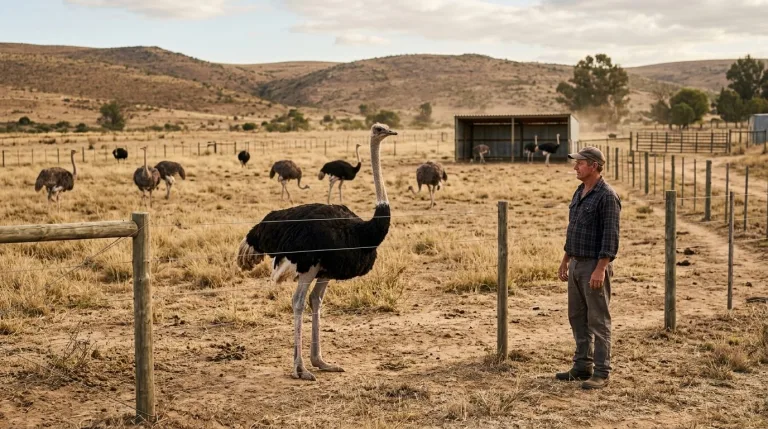
Have you ever seen a bird that can outrun a horse, kick hard enough to kill a lion, and lay the largest eggs in the entire animal kingdom? That’s the ostrich for you. These giant birds have fascinated humans for thousands of years, and today you’ll find them on farms across South Africa, Australia, and even parts of South Asia. But here’s the question that gets people talking: are ostriches actually domesticated, or are they just wild animals that humans have learned to manage?
The answer isn’t as simple as yes or no, and understanding it opens up a fascinating conversation about animal behavior, farming history, and what domestication really means. By the time you finish reading this, you’ll have a clear picture of where the ostrich stands, and whether farming one is as straightforward as raising a goat or a chicken.
What Does “Domesticated” Actually Mean?
Before we judge the ostrich, it helps to understand what true domestication looks like. Domestication is a long biological process, usually spanning hundreds to thousands of years, in which a wild species gradually changes through selective breeding to become adapted to living alongside humans. Dogs came from wolves, cattle came from wild aurochs, and chickens descended from jungle fowl in Southeast Asia. These aren’t just tamed animals; they are biologically transformed ones.
Domesticated animals share key traits: they stay calm around humans, they breed predictably in captivity, and over generations their genetics shift in ways that make them more comfortable with human care. True domestication is not just about keeping an animal in a pen. It’s about a deep, generational relationship between two species.
A Quick Look at the Ostrich: Not Your Average Bird
The ostrich (Struthio camelus) is the world’s largest living bird. Adults can reach 2.7 meters in height and weigh up to 156 kilograms. They can sprint at 70 kilometers per hour, making them the fastest running bird on the planet, and their powerful legs can deliver a forward kick strong enough to seriously injure a large predator.
They’re native to the African savanna and live in semi-arid plains, open woodlands, and grasslands. In the wild, they live in flocks, stay sharply alert to threats, and rely on speed as their primary escape strategy. Their temperament can be unpredictable, and they retain a strong flight-or-fight instinct that doesn’t disappear simply because they’re enclosed on a farm.
The History of Ostrich Farming
Humans have been farming ostriches commercially for about 150 years. The industry started in earnest in South Africa during the 1860s, when ostrich feathers became one of the most fashionable accessories in Europe and North America. Feather plumes decorated women’s hats, demand was enormous, and ostrich farming became highly profitable for South African farmers in a very short time.
When feather fashion faded after World War I, the industry shifted its focus. Farmers moved toward ostrich leather (considered one of the most durable luxury leathers in the world), ostrich meat (a lean red meat lower in fat than beef), and ostrich eggs (one egg is equivalent to roughly 24 chicken eggs). Today, South Africa, Zimbabwe, Kenya, Israel, and parts of Europe all have established ostrich farming industries.
So Are Ostriches Domesticated? The Honest Answer
Here’s where things get interesting. Ostriches have been farmed and selectively bred for over a century, which means they do show some adaptation to human environments compared to their fully wild counterparts. Farmed ostriches are generally more tolerant of human presence, and certain breeds like the South African Black ostrich have been specifically developed for commercial production.
However, ostriches are not domesticated in the true biological sense. They retain nearly all of their wild instincts, including territorial aggression, strong stress responses, and unpredictable behavior under pressure. Unlike a dairy cow that walks calmly into a milking shed, ostriches can injure their handlers without warning, and farmers who work with them must be properly trained.
Think of it this way: a farmed ostrich is closer to a managed wild animal than a domesticated one. It’s similar to how fish farms raise barramundi or trout, species that remain biologically wild but are produced under controlled conditions. The difference is in the management system, not in the animal’s fundamental nature.
What Can You Get from Ostrich Farming?
Despite the challenges, ostrich farming offers some genuinely impressive returns, which is why interest in the industry continues to grow in countries like Pakistan and other parts of Asia.
- Ostrich meat is lean, rich in protein, and lower in cholesterol than beef or lamb, making it attractive to health-conscious consumers.
- Ostrich leather is prized in the luxury goods market, and a single hide can command high prices in international trade.
- Ostrich eggs have real culinary and decorative value, with one egg capable of feeding an entire family.
- Ostrich feathers still see demand in fashion, décor, and cleaning product industries.
- Ostrich fat is used in cosmetic and pharmaceutical formulations in several markets.
The challenge is in the setup. Ostriches need large open spaces, specialized fencing, a specific diet, and experienced handlers. The initial investment is significant, and managing these birds demands patience and consistent professional training.
Can You Keep an Ostrich as a Pet?
People do keep ostriches as pets in some countries, and small hobby farmers sometimes raise one or two birds on their property. But it’s important to be realistic: ostriches are not companions in the way that dogs or goats are. They can become attached to familiar caretakers over time, but they can also be aggressive, especially during mating season when males grow highly territorial.
If you’re considering ostriches as part of a farm operation, the right approach is to treat them as a managed commercial livestock species, not a tame companion animal. Investing in proper infrastructure, veterinary support, and handler training is not optional. It is the difference between a productive operation and a genuinely dangerous one.
Ostriches sit in a fascinating middle ground: too managed to be truly wild, but too instinct-driven to be truly domesticated. What makes them remarkable is that despite this, they have become a viable commercial farming species with real economic value in global markets. As consumer interest in lean meats, exotic leathers, and sustainable farming continues to grow, ostriches will only become more relevant to regional agriculture.
If you’re curious about livestock farming options in Pakistan, from traditional cattle and poultry to more unconventional choices, Multanfarms.com is your go-to resource for practical, honest agricultural knowledge rooted in local expertise.