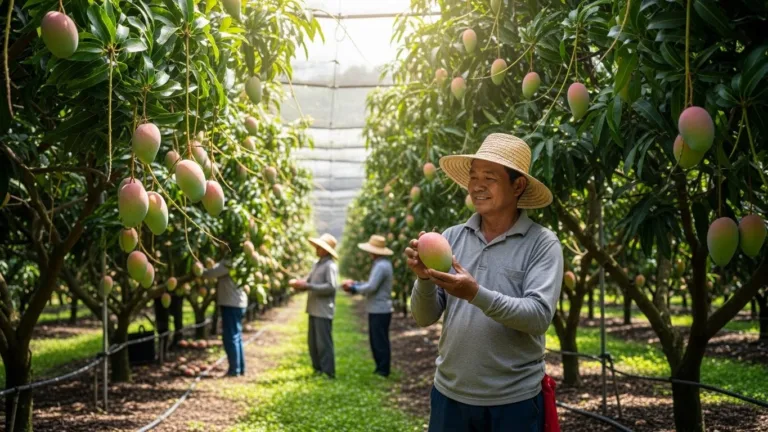
Imagine walking through rows and rows of beautiful mango trees, their branches heavy with golden, sweet-smelling fruit. Sounds like paradise, right? But here’s something you might not know: those delicious mangoes don’t just grow themselves. Behind every perfect mango is a farmer who knows exactly how to take care of their orchard. It’s like being a coach for a sports team, except instead of training athletes, you’re helping trees reach their full potential!
Managing a mango orchard is way more complicated than just planting some trees and waiting for fruit to appear. It’s actually a year-round job that requires planning, patience, and a lot of knowledge about how mango trees grow. From choosing the right location to protecting the trees from pests, every decision a farmer makes can affect how tasty and plentiful the harvest will be.
In this article, we’ll explore the fascinating world of mango orchard management and discover what it really takes to grow those sweet, juicy fruits that so many people love. Whether you’re curious about farming, thinking about a future career in agriculture, or just want to appreciate your next mango a little more, you’re in for a treat!
Starting Strong: Choosing the Right Spot and Trees
Before a single mango tree goes into the ground, farmers have to make some really important decisions. First up is location, and this matters more than you might think! Mango trees are kind of picky about where they live. They love sunshine (at least 6-8 hours a day), warm temperatures, and soil that drains water well. Think of it like choosing the perfect spot for your bedroom. You wouldn’t want it too cold, too dark, or in a place where water pools up, right?
The soil needs to be just right too. Farmers test the soil to make sure it has the right pH level (that’s how acidic or basic it is) and contains enough nutrients. Mango trees prefer slightly acidic soil, kind of like how goldfish prefer water at a certain temperature. If the soil isn’t perfect, farmers can add things like compost or fertilizer to improve it. It’s like giving the trees a vitamin boost before they even start growing!
Choosing which type of mango tree to plant is another huge decision. There are hundreds of mango varieties, and each one is a little different. Some produce sweeter fruit, some are better at resisting diseases, and some can handle hotter or cooler weather. Farmers often pick varieties that grow well in their specific region and that customers want to buy. It’s like how a chef chooses ingredients based on what dish they’re making and what their customers enjoy eating.
Planting Day: Getting Trees Off to a Great Start
When it’s finally time to plant, farmers need to space the trees correctly. This is super important! If trees are too close together, they’ll compete for sunlight, water, and nutrients, kind of like how it’s hard to study when you’re squished at a crowded table. If they’re too far apart, the farmer is wasting valuable land. Most mango trees are planted about 25-30 feet apart, giving each tree plenty of room to spread its branches.
The actual planting process takes care and attention. Farmers dig holes that are deep and wide enough for the roots to spread out comfortably. They make sure the tree is planted at the right depth, not too shallow and not too deep. It’s a bit like planting a flag in the ground, you want it stable and secure. After planting, the trees get a good watering to help them settle into their new home.
Young mango trees need extra protection in their first few years. Farmers might put up small fences to keep animals away or use shade cloth to protect baby trees from intense sun. It’s similar to how parents are extra careful with young children until they’re old enough to handle things on their own. During this time, regular watering is crucial because the trees are establishing their root systems.
Feeding and Watering: Keeping Trees Healthy and Happy
Just like you need food and water to grow strong, mango trees need regular care to produce the best fruit. Watering is a bit of an art form in mango orchard management. Too little water, and the trees get stressed and might drop their fruit early. Too much water, and the roots can rot. Many modern farms use drip irrigation systems, which deliver water directly to the roots through small tubes. It’s like having a personalized water bottle for each tree!
The watering schedule changes throughout the year. During flowering season (when the trees are making flowers that will become mangoes), farmers actually reduce watering a bit. This might sound strange, but a little bit of “stress” actually encourages the trees to produce more flowers. It’s kind of like how sometimes a challenge can motivate you to work harder. Once the fruit starts growing, though, the trees need plenty of water to help those mangoes get big and juicy.
Fertilizing is another key part of keeping mango trees healthy. Trees need nutrients like nitrogen, phosphorus, and potassium (you might see these as N-P-K on fertilizer bags). Farmers apply fertilizer several times a year, with the amounts and timing depending on the trees’ age and the soil conditions. Young trees get different amounts than mature trees, just like how a toddler eats less than a teenager! Some farmers also use organic fertilizers like compost or manure, which slowly release nutrients over time.
Fighting the Bad Guys: Pest and Disease Management
Mango trees face threats from various pests and diseases, and protecting the orchard is a constant battle. Some of the biggest troublemakers are fruit flies, which lay eggs inside developing mangoes. When the eggs hatch, the larvae eat the fruit from the inside, making it inedible. Imagine finding a worm in your apple, gross, right? That’s what farmers are trying to prevent!
Other common problems include mango hoppers (tiny insects that suck juice from flowers), powdery mildew (a fungus that looks like white powder on leaves), and anthracnose (a disease that causes black spots on fruit). Farmers use different strategies to deal with these issues. Some use pesticides, which are chemicals that kill pests, but they have to be very careful to use them safely and at the right times. It’s like taking medicine, you need the right dose at the right time.
Many farmers today are using something called Integrated Pest Management, or IPM for short. This approach combines different methods to control pests while using fewer chemicals. For example, they might release helpful insects that eat the bad insects, kind of like hiring bodyguards for your trees! They also remove diseased branches quickly to stop problems from spreading, use traps to catch pests, and keep the orchard clean by removing fallen fruit where pests might hide.
Pruning and Training: Giving Trees the Perfect Shape
Pruning means cutting off certain branches, and it’s one of the most important jobs in mango orchard management. You might wonder why anyone would want to cut parts off a perfectly good tree, but there are really good reasons! Pruning helps control the tree’s size (making it easier to harvest fruit), removes dead or diseased branches, and allows sunlight to reach all parts of the tree. Think of it like getting a haircut, sometimes you need to trim things back to keep everything healthy and looking good.
There’s a right time and a wrong time to prune mango trees. Most farmers do major pruning right after harvest, when the trees have finished producing fruit for the season. This gives the trees time to recover and grow new branches before the next flowering season. Light pruning can happen throughout the year to remove problem branches, but farmers avoid heavy pruning during flowering or when fruit is developing.
The way a farmer prunes can also affect how much fruit the tree produces. They want to create an “open center” shape that looks kind of like a vase or umbrella. This shape allows air to flow through the branches (which helps prevent diseases) and lets sunlight reach the interior branches. It’s like organizing your closet so you can see and reach everything easily. Well-pruned trees are easier to manage and typically produce better quality fruit.
Harvest Time: Picking Fruit at the Perfect Moment
After months of careful management, harvest time is when all that hard work pays off! But here’s the tricky part: knowing exactly when to pick the mangoes. Pick them too early, and they won’t be sweet enough. Pick them too late, and they might be overripe or damaged. Experienced farmers can tell when mangoes are ready by looking at their color, feeling their firmness, and even smelling them. Some varieties change color when ripe, while others stay green, so farmers need to know their specific variety really well.
Harvesting is usually done by hand, with workers using long poles with baskets or bags attached to reach high branches. They’re super careful not to bruise or damage the fruit because even a small bruise can cause the mango to spoil quickly. It’s kind of like handling eggs, you need a gentle touch! Some farms use special cushioned containers to transport the mangoes without bumping them around too much.
After picking, the mangoes go through a sorting process. Workers check each one for quality, separating them by size and ripeness. The best-looking fruits might go to high-end markets, while slightly smaller or less perfect ones might be used for making mango products like juice, dried mango, or jam. Nothing goes to waste! Some farms even have their own processing facilities where they can add value to their crop.
Why Good Orchard Management Really Matters
So why is all this management stuff so important? Well, properly managed orchards produce way more fruit than neglected ones. A well-cared-for mango tree can produce hundreds of pounds of fruit each year for decades! That means more income for farmers and more delicious mangoes for everyone else. It’s a win-win situation.
Good management also means healthier trees that can resist diseases and pests better. This is important because it means farmers can use fewer chemicals, which is better for the environment and for the people who eat the fruit. Plus, healthy orchards can last for 40-50 years or even longer, providing food and income for multiple generations. It’s like investing in something that keeps giving back over and over again.
Managing a mango orchard takes dedication, knowledge, and a real love for what you’re doing. It’s not just about growing fruit, it’s about understanding nature, solving problems, and working with the seasons. Every decision a farmer makes, from where to plant to when to water to how to prune, affects the quality and quantity of the harvest.
Next time you bite into a sweet, juicy mango, take a moment to think about all the work that went into growing it. Someone planted that tree, watered it through dry spells, protected it from pests, pruned it carefully, and picked the fruit at just the right moment. That’s the magic of mango orchard management! Have you ever thought about what goes into growing the food you eat every day? It’s pretty amazing when you stop and think about it!