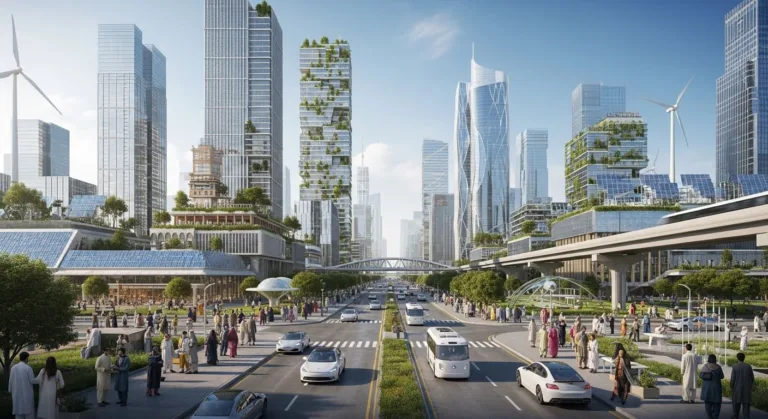
Imagine walking into a classroom in the year 2070. You’re not even born yet, but somewhere in the world, a kid your age is learning about how countries’ economies have changed over the past fifty years. They’re reading about Pakistan and discovering something pretty incredible: their country might be one of the world’s six biggest economies! Sounds like science fiction, right? But according to experts who study money, trade, and how countries grow, it’s actually a real possibility.
You might be wondering, “What does it even mean to be a ‘big economy,’ and why should I care about something that’s 44 years in the future?” Great questions! Understanding how countries’ economies might change over time is like watching a really long movie about how the world is transforming. It helps us see patterns, make smart choices today, and understand what opportunities might exist for future generations. Plus, it’s pretty cool to imagine what the world might look like when you’re older!
Let’s dive into the fascinating predictions experts are making about Pakistan’s economic future and explore what it all means.
What’s GDP, and Why Does It Matter?
Before we talk about the future, we need to understand what GDP actually is. GDP stands for Gross Domestic Product, which is basically a way to measure how much stuff a country makes and sells in a year. Think of it like this: if your class had a bake sale, and you wanted to measure how successful it was, you’d count up all the money from every cookie, brownie, and cupcake sold. That total would be like your class’s “GDP.”
For a country, GDP includes everything from mangoes grown on farms (like those at Multanfarms.com in Multan!) to cars manufactured in factories, from haircuts at salons to apps developed by tech companies. It’s all the goods and services produced within a country’s borders added together. The bigger the GDP, the more economic activity is happening, which usually means more jobs, more opportunities, and generally more wealth floating around.
Pakistan’s economy is currently ranked 24th in the world with a GDP at PPP (purchasing power parity) of about $988 billion Dawn. But here’s where it gets interesting: experts predict this could change dramatically over the next several decades!
The Big Prediction: Pakistan Could Be #6 by 2075
Here’s the headline that’s got economists talking: according to Goldman Sachs, a major investment banking firm, Pakistan could become the sixth largest economy in the world by 2075 Arab News PK. That’s a massive jump from where it is today!
By 2075, Pakistan’s real GDP is forecast to have grown to $12.7 trillion, with GDP per capita (that’s the average amount per person) reaching $27,100 The Express Tribune. To put that in perspective, imagine if everyone in Pakistan, on average, had about the same purchasing power as someone in a moderately wealthy country today. That’s a huge improvement from current levels!
The predicted top six economies by 2075 would be: China in first place, India in second, the United States in third, Indonesia fourth, Nigeria fifth, and Pakistan sixth. Notice something interesting? Most of these are Asian or African countries, not the European nations that dominated the world economy for centuries!
Why Would Pakistan’s Economy Grow So Much?
You might be thinking, “Okay, but how is this supposed to happen?” It’s not magic, there’s actual science and math behind these predictions. The main reason is something you probably take for granted: population growth.
Pakistan’s future economic status is predicted on the back of its population growth, which along with Egypt and Nigeria, could place it among the largest economies in the world in the next 50 years Dawn. More people generally means more workers, more consumers buying things, and more brains coming up with new ideas and businesses.
Think of it like a school growing from 500 students to 2,000 students. Suddenly, you need more teachers (jobs!), more school supplies are being bought (economic activity!), and there are more students participating in activities, sports, and clubs (even more economic activity!). The same principle applies to countries.
Pakistan is projected to enjoy one of the highest growth rates in working age population, at near two percent throughout 2050, second only to Nigeria The News. Working age population means people who are old enough to have jobs and contribute to the economy. That’s like having more and more people join your bake sale committee every year, each one bringing new energy and ideas!
It’s Not Automatic: The “If” Factor
Now here’s the important part that makes this whole prediction less like a guarantee and more like a “what if” scenario. The report warned that climate catastrophes and populist leaders were risks to its projections Arab News PK. In other words, Pakistan reaching #6 isn’t automatic. It depends on making smart choices today and in the years to come.
What kind of choices? Well, experts say countries need good policies and strong institutions (that means well-functioning governments, courts, schools, and businesses). Pakistan’s progress will depend on being able to generate enough jobs for the young people in their countries; if they cannot do this, it could be a cause of political instability The News.
Imagine if your school kept accepting more and more students but didn’t build any new classrooms, hire new teachers, or buy more supplies. Eventually, things would get pretty chaotic, right? Countries face similar challenges. Growing populations are great, but only if there are enough jobs, schools, hospitals, and infrastructure to support everyone.
The Stepping Stones: 2030 and 2050
Before we get to 2070 or 2075, let’s look at the stepping stones along the way. By 2030, Pakistan is projected to climb to 20th place with a GDP at PPP of $1.87 trillion, and by 2050, it could reach 16th place with $4.2 trillion Dawn.
So the journey looks something like this:
- Today (2026): 24th largest economy
- 2030: 20th largest economy
- 2050: 16th largest economy
- 2075: 6th largest economy (projected)
Each jump represents years of growth, development, and change. It’s not an overnight transformation but rather a gradual climb up the economic ladder.
What This Means for Real People
All these trillions of dollars and rankings might seem abstract, so let’s bring it down to earth. What would it actually mean for regular people if Pakistan becomes the sixth largest economy?
Pakistan’s per capita income is projected to grow from $0.9 thousand in 2000 to $27.1 thousand by 2075 Southasiainvestor. That’s about 30 times more! Imagine if your weekly allowance went from $2 to $60. You could buy way more stuff, save for bigger goals, and have more choices about how to spend your money.
Higher GDP per capita usually means better roads, more schools, better hospitals, more job opportunities, and generally improved quality of life. It could mean farmers in Multan have access to better technology for growing their famous mangoes, students have more educational opportunities, and families can afford things that seem out of reach today.
The Big Picture: A Changing World
Here’s something really fascinating about these predictions: global GDP growth is expected to average about 2.5% per year, slower than the 3.7% average between 2000 and 2019 Capital Economics. The whole world’s economy is actually expected to grow more slowly in the future!
So how can Pakistan move up in the rankings if global growth is slowing down? It’s because developed countries (like the United States, Japan, and European nations) are growing even more slowly than the global average. China’s potential growth rate is projected to fall below that of the United States by 2040-45 and below zero by 2070-75 OECD. As older, richer countries slow down due to aging populations and other factors, younger, growing countries like Pakistan have the chance to catch up.
It’s kind of like a race where the leaders are getting tired and slowing their pace, giving the runners behind them a chance to close the gap.
The Challenges Ahead
Of course, predictions aren’t promises, and there are serious challenges to overcome. Climate change is a huge concern. Pakistan is particularly vulnerable to extreme weather events like floods, droughts, and heat waves, which can damage crops, destroy infrastructure, and harm people’s livelihoods.
There’s also the challenge of education. To turn population growth into economic growth, countries need educated workers who can do complex jobs, start businesses, and innovate. If young people don’t get good educations, having a large population could actually become a problem rather than an advantage.
Additionally, countries need good infrastructure (roads, electricity, internet, water systems) and stable political systems. Think of these as the foundation of a house. No matter how nice you want the house to be, if the foundation is weak, the whole thing could come crashing down.
Looking Forward: Your Future, Your World
So what does all this mean for you? Well, if you’re reading this in 2026, you’ll be in your 50s or 60s in 2070. The world these predictions describe isn’t some distant, irrelevant future, it’s potentially YOUR world as an adult.
The choices that Pakistan makes in the next few decades about education, environment, technology, and governance will shape what opportunities exist for your generation. Will there be enough jobs? Will the environment be protected? Will cities have good infrastructure? These are all questions that depend on actions taken starting right now.
Understanding economic predictions like these helps us see the big picture of how the world is changing. Countries rise and fall in economic rankings, power shifts from one region to another, and opportunities emerge in unexpected places. Emerging markets will continue to converge with industrial nations, with China, the US, India, Indonesia and Germany topping the league table of largest economies when measured in dollars The Express Tribune.
The Bottom Line
Could Pakistan really be the sixth largest economy by 2070 or 2075? According to experts at Goldman Sachs and other institutions, it’s definitely possible, but it’s not guaranteed. It depends on factors like population growth continuing, good policies being implemented, jobs being created for young people, education improving, and climate challenges being managed.
The future is never certain, but understanding these projections helps us see potential paths forward. It shows us what’s possible if smart choices are made and challenges are addressed. Whether Pakistan actually reaches that #6 spot will depend on millions of decisions made by leaders, business owners, farmers, teachers, students, and ordinary citizens over the next several decades.
Here’s something to think about: What role might you play in Pakistan’s economic future? Whether you become a farmer improving agricultural productivity, an entrepreneur starting new businesses, an engineer building infrastructure, a teacher educating the next generation, or a citizen making informed choices, you’ll be part of shaping whether these predictions come true or not.
The future isn’t something that just happens to us, it’s something we help create. What kind of future do you want to help build?