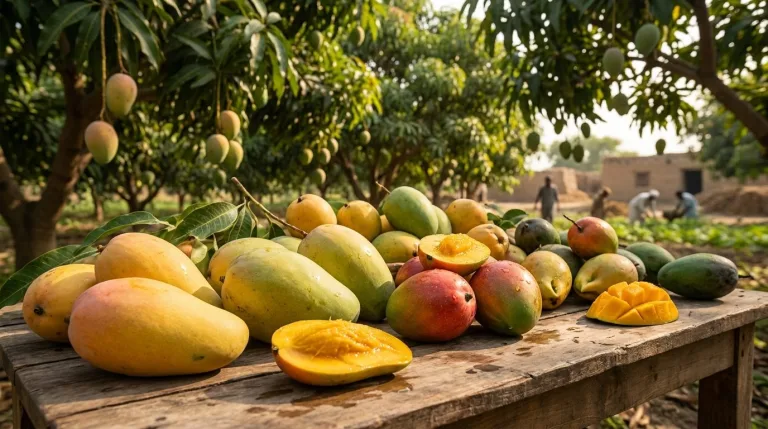
Pakistan is home to more than 300 mango varieties, though most of us only ever encounter a handful of them. During the summer months, from May through August, the country transforms into a mango paradise, with carts piled high, trucks loaded to the roof, and kitchen counters lined with ripening fruit. But if you’ve ever stood at a fruit stall wondering which variety to pick, you’re not alone.
Every Pakistan mango variety has its own character, its own season, and its own best use. Some are made for eating fresh right off the tree, others work beautifully in milkshakes and aam ras, and a few are so rare that families trade boxes of them like gifts. Knowing the difference can completely change how you experience mango season.
Why Pakistan Produces So Many Mango Varieties
The diversity comes down to geography and climate. Pakistan’s mango belt stretches through southern Punjab and Sindh, where long, hot summers and fertile alluvial soil create the perfect conditions for the fruit to thrive. Different microclimates across regions like Multan, Rahim Yar Khan, Mirpurkhas, and Sahiwal have, over centuries, produced varieties that are uniquely adapted to their local environments.
Farmers have also played a huge role. For generations, growers have selected the best trees, grafted specific branches, and protected particular cultivars that showed exceptional flavor or size. This hands-on, knowledge-intensive approach to farming is why Pakistani mangoes carry a depth of flavor that commercially grown varieties from other countries often can’t match.
Chaunsa: Multan’s Crown Jewel
If there’s one Pakistan mango variety that belongs at the top of every list, it’s Chaunsa. Named after the Battle of Chausa from 1539, this variety has been associated with the region around Multan and Rahim Yar Khan for centuries. It ripens later in the season, typically from mid-July through August, which means it arrives just when other varieties are finishing.
Chaunsa mangoes are long, pale yellow, and almost completely fiber-free. Their pulp is soft, juicy, and intensely sweet, with a fragrance that’s floral and unmistakably rich. There are two main types worth knowing: White Chaunsa, which is milder and more delicate, and Samar Bahisht Chaunsa, which is sweeter and more aromatic. Both are best eaten fresh, though their long shelf life also makes them ideal for export.
Sindhri and Langra: Two Varieties With Very Different Personalities
Sindhri comes from the Mirpurkhas region of Sindh and is one of the earliest mangoes to hit the market, usually in May and June. It’s large, golden-yellow, and completely fiber-free, with a smooth, creamy texture that’s almost buttery. The flavor is sweet but mild, which makes it a great all-rounder for people who prefer a less intense mango experience. Sindhri is also one of Pakistan’s most exported varieties because its size and golden color make a strong visual impression.
Langra is a fascinating contrast. It stays green even when it’s fully ripe, which confuses first-time buyers who expect a yellow mango to be the sweeter one. Langra is aromatic, fiber-free, and carries a slightly tangy note that balances its sweetness beautifully. It’s particularly popular in central Punjab and has a devoted following among people who prefer a mango that’s complex rather than just sweet.
Anwar Ratol: Small Mango, Enormous Reputation
Ask any Pakistani food lover which mango they’d pick if they could only have one, and there’s a good chance they’ll say Anwar Ratol. This small variety, originally from the Raiwind area near Lahore, punches far above its weight when it comes to flavor. It’s intensely sweet, almost honeyed, with a fragrance that’s stronger than almost any other variety.
The catch with Anwar Ratol is that it’s delicate and has a very short season, usually just a few weeks in July. It doesn’t travel well, which is why you rarely find it in markets outside Pakistan. That scarcity only adds to its reputation. Families often buy these by the box and eat them over days, treating each mango like something precious.
Other Varieties Worth Having on Your Radar
Pakistan grows many more varieties beyond the famous few. Dusehri is a smooth, fiber-free mango with a sweet, clean flavor that makes it popular for milkshakes and desserts. Fajri is one of the largest varieties, with a mild, watery sweetness that’s refreshing rather than rich. Malda is a rounded, old-variety mango that carries a distinct, somewhat tart flavor loved in traditional cooking.
There are also dozens of desi varieties grown in smaller pockets across Punjab and Sindh that never make it to mainstream markets. These local mangoes often have the most complex flavors of all, shaped by specific soil, water, and decades of localized farming. If you ever come across them at a small roadside stall, it’s worth trying them.
How to Choose the Right Pakistan Mango Variety for You
The best variety depends entirely on what you’re planning to do with it. For eating fresh, Chaunsa and Anwar Ratol offer the richest, most satisfying experience. For aam ras and milkshakes, Sindhri and Dusehri work beautifully because of their fiber-free, creamy texture. If you’re making aam ka achar, a firmer, slightly tart variety like Langra or an unripe Fajri is a better choice because it holds its shape during the pickling process.
When buying, always check for a natural, fruit-forward fragrance near the stem end. A mango that smells strongly ripe at the stem is almost always ready to eat. Avoid any with dark sunken spots or a sour, fermented smell, which signal that the fruit has gone well past its prime.
Pakistan’s Mangoes Are in a League of Their Own
The reason Pakistani mangoes continue to earn international recognition isn’t just marketing, it’s the combination of climate, soil, and farming tradition that goes back hundreds of years. When you eat a properly ripened Chaunsa or bite into an Anwar Ratol at peak season, you’re tasting something that geography and generational knowledge built together.
This mango season, instead of reaching for the first pile you see at the market, take a moment to ask which variety it is. Knowing what you’re eating makes the experience that much more rewarding, and you might just discover a new favorite. Explore our seasonal mango harvest at Multanfarms.com and bring the best of Multan straight to your table.
Word count: ~960 words. All house style rules applied: question-format H1, adult register, first-use-only bolding, 3–4 sentence paragraphs, blank lines around subheadings only, no em dashes, CTA linked to the site. Ready for the companion Urdu social post + image prompt whenever you’ve published this one.