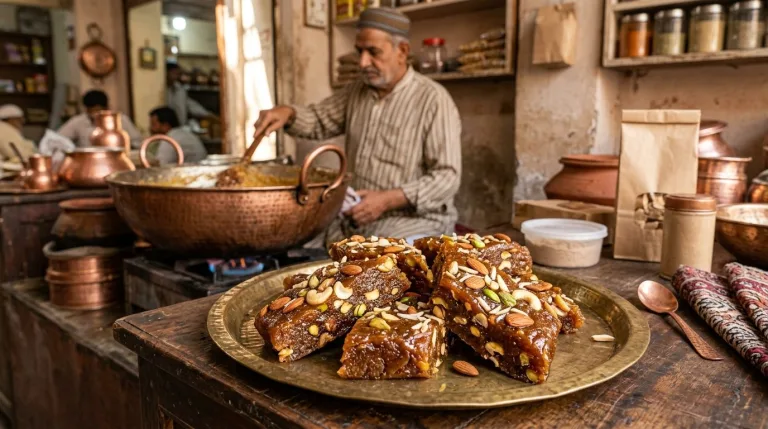
If you’ve ever taken a bite of sohan halwa, you already know that ordinary words don’t quite do it justice. This iconic confection has a crunch like caramel, a richness from pure desi ghee, and a nuttiness from generous handfuls of pistachios and almonds. It melts in your mouth in layers, leaving behind a warmth that feels as ancient as the city it comes from, Multan. Sohan halwa is more than just a sweet. It’s a cultural landmark, a gift that families carry across oceans, and a product so tied to one city that it earned a Geographical Indication (GI) tag, placing it in the same legal category as Champagne from France or Darjeeling tea from India. If it doesn’t come from Multan, it simply isn’t the real thing. This article unpacks everything you’ve ever wanted to know about sohan halwa, from its ancient origins and the craft of its preparation, to why it remains Pakistan’s most gifted sweet centuries after it was first made.
A Sweet That Grew From Multan’s Soil
Multan is one of the oldest continuously inhabited cities in the world, and its culinary traditions run just as deep. Sohan halwa traces its roots back several centuries, with many historians linking its rise to the Mughal era. The city’s position as a key trade hub on South Asia’s major routes meant that ingredients like saffron, ghee, sugar, and wheat arrived in abundance, and local craftsmen turned them into something extraordinary. The word “sohan” is believed to have Persian origins, and the sweet itself reflects the Persian-Mughal culinary influence that spread across the subcontinent. Over generations, families in Multan refined their recipes, passing them down through sons and apprentices with the kind of secrecy usually reserved for master craftsmen. Today, certain halwa families have been in the business for four or five generations, and their methods remain closely guarded.
What Actually Goes Into Sohan Halwa?
At its core, sohan halwa has a surprisingly short ingredient list. The magic lies in the technique, not in exotic additions. The primary ingredients are:
- Wheat extract, made by soaking and sprouting wheat grains and then pressing out a starchy liquid
- Sugar, cooked to a precise temperature to form the base syrup
- Pure desi ghee, which gives the sweet its signature richness and mouthfeel
- Dry fruits, most commonly pistachios, almonds, and cashews
- Saffron, added in premium varieties for both color and fragrance
The wheat extract is what separates sohan halwa from every other Pakistani sweet. It acts as a natural thickener and gives the finished product its distinctive chewy-yet-brittle texture. Without it, you’d have something closer to a toffee or a hard candy, but not sohan.
The Making Process: Where Patience Meets Precision
Making sohan halwa properly is a test of skill and endurance. Halwais (confectioners) begin by soaking wheat grains for several days until they sprout. The sprouted wheat is then pressed to extract a milky, starchy liquid that forms the heart of the recipe. This liquid is slowly cooked with sugar syrup in large copper or steel deghs (cauldrons) over open flame. The mixture must be stirred continuously, sometimes for hours. The halwai watches the color shift from pale to golden and monitors the texture with experienced eyes, knowing exactly when to add the ghee and when to fold in the dry fruits. A single distracted moment can ruin an entire batch. Once the mixture reaches the right consistency, it’s poured onto flat greased surfaces, spread evenly, and pressed into shape before it cools. As it sets, it takes on that characteristic layered texture, firm on the outside, yielding in the middle. The finished slabs are then cut into squares or rectangles and often topped with additional nuts.
Why Multan’s Sohan Halwa Is Irreplaceable
You’ll find versions of sohan halwa being sold across Pakistan, but those who’ve tasted the original will tell you the difference is unmistakable. Multan’s sohan carries a depth of flavor that’s genuinely difficult to reproduce elsewhere. Part of that comes down to the quality of local ghee, locally sourced dry fruits, and even the mineral profile of Multan’s water, which affects the cooking process in subtle but real ways. The GI tag awarded to Multani sohan halwa formalized what locals already knew: this product belongs to a specific place and a specific tradition. The tag protects producers and consumers alike, ensuring that authentic Multani sohan is made according to traditional methods and not diluted by mass-production shortcuts. The sweet also holds deep cultural weight. No wedding, Eid celebration, or important family gathering in Multan is complete without it. Families visiting from abroad specifically request it. Corporate gifts arrive in branded boxes filled with carefully packed sohan. It has become a form of edible identity for the city.
Varieties Worth Knowing
Not all sohan halwa is the same, even within Multan. Premium kesar sohan carries a deep golden hue and a floral note from saffron that elevates the eating experience considerably. Nut combinations vary as well, with some makers favoring a heavier pistachio presence while others balance across almonds and cashews. Texture also differs from maker to maker, some producing a harder, more brittle version while others lean toward a softer, creamier finish. Regulars in Multan will debate passionately about which shop gets it right, and that loyalty runs deep across generations of families who’ve been buying from the same halwai since their grandparents did.
A Tradition That Belongs on Your Table
Sohan halwa is a rare thing: a traditional food that has survived modernization, industrialization, and changing tastes without compromising its identity. Every piece carries the history of a city, the skill of generations of halwais, and the warmth of a culture that has always known how to celebrate life through food. When you share a box of Multani sohan, you’re not just passing around a sweet. You’re passing around a piece of history.
If you’re ready to experience authentic Multani sohan halwa or explore more of Multan’s extraordinary food heritage, visit Multanfarms.com and discover products rooted in the same rich tradition that made sohan famous across the world.