Picture this: you’re sitting down for dinner, and your plate is loaded with crispy okra, juicy tomatoes, and perfectly spiced potatoes. Ever wonder where all those vegetables came from? If you’re in Punjab, Pakistan, there’s a good chance they were grown right in your own province! Punjab isn’t just famous for its mangoes and wheat, it’s actually a vegetable powerhouse that feeds millions of people across the country.
Punjab’s unique climate, rich soil, and hardworking farmers make it one of the best places in Pakistan for growing all kinds of vegetables. From the leafy greens your parents keep telling you to eat more of, to the potatoes that make your favorite fries, Punjab’s farms produce an incredible variety of fresh veggies year-round. Understanding what grows here and why can help you appreciate that salad a lot more (okay, maybe just a little more).
In this article, we’ll explore the fascinating world of vegetable farming in Punjab. You’ll discover which vegetables thrive in different seasons, why Punjab’s climate is perfect for farming, and how places like Multanfarms.com are working to bring fresh, locally-grown vegetables to your table. By the end, you might just look at your dinner plate with a whole new level of respect!
Why Punjab is a Vegetable Paradise
Punjab literally means “land of five rivers,” and those rivers, the Jhelum, Chenab, Ravi, Beas, and Sutlej, have been feeding the region’s farmland for thousands of years. When rivers flow through an area, they deposit nutrient-rich soil along their banks, kind of like how your mom adds vitamins to your smoothie to make it healthier. This natural fertilization makes Punjab’s soil incredibly fertile, which is just a fancy way of saying it’s perfect for growing plants.
But it’s not just about the soil. Punjab has what farmers call a “diverse climate,” meaning it experiences different seasons throughout the year. Hot summers, cool winters, and monsoon rains create the perfect conditions for growing different vegetables at different times. It’s like having multiple growing seasons instead of just one, which means farmers can plant something new almost all year long!
The temperature range in Punjab is also ideal for vegetables. Most veggies are pretty picky about their weather, they don’t like it too hot or too cold. Punjab’s climate hits that sweet spot, especially during spring and autumn. Add in the hardworking farmers who’ve been perfecting their techniques for generations, and you’ve got a recipe for agricultural success!
Winter Vegetables: The Cool-Season Champions
When winter arrives in Punjab (roughly from November to February), the vegetable scene completely changes. This is when cool-season vegetables take over the fields. These are plants that actually prefer cooler temperatures and would struggle in summer’s intense heat.
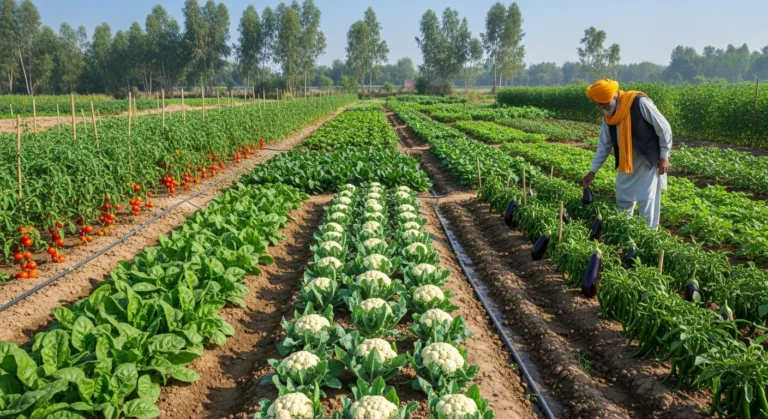
Cauliflower and cabbage are the superstars of Punjab’s winter vegetable lineup. Drive through rural Punjab during winter, and you’ll see fields absolutely packed with these white and green beauties. Farmers love growing them because they’re hardy (meaning tough and resistant to cold), and people love eating them because they’re versatile. You can fry them, boil them, pickle them, or add them to curries. That gajar ka halwa (carrot dessert) your grandmother makes? Those sweet carrots are also winter vegetables that grow amazingly well in Punjab’s cool months.
Other winter favorites include spinach (palak), turnips, radishes, and several types of peas. Here’s something cool: these vegetables actually taste sweeter when grown in cooler weather! When temperatures drop, these plants convert their starches into sugars as a kind of natural antifreeze. So that crispy radish or sweet pea you’re eating isn’t just fresh, it’s been naturally sweetened by the winter chill. Nature’s pretty clever, right?
Farms like Multanfarms.com take advantage of these perfect winter conditions to grow high-quality vegetables that end up in markets across the region. They understand that timing is everything in farming, plant at the right time, and you’ll get the best possible harvest.
Summer Vegetables: Heat-Loving Crops
Once summer rolls around (March to June), Punjab’s fields transform again. The winter vegetables can’t handle the heat, so they’re replaced by vegetables that absolutely love hot weather. If winter vegetables are like people who enjoy ice skating, summer vegetables are like people who love lounging on a hot beach!
Tomatoes are huge in Punjab during summer. These bright red fruits (yes, technically they’re fruits, but we use them like vegetables) need plenty of sunshine and warmth to develop their flavor. Punjab’s hot, dry summers are perfect for growing sweet, juicy tomatoes that are way better than anything you’d find in a store during winter.
Okra (bhindi), eggplant (baingan), bottle gourd (lauki), and bitter gourd (karela) are other summer champions. These vegetables need heat to grow properly, and Punjab delivers! The long, sunny days give these plants all the energy they need to produce lots of vegetables. It’s like how you have more energy to play outside on a bright, sunny day compared to a gloomy, cloudy one.
One interesting thing about summer vegetables in Punjab is that many of them have high water content, which helps keep people hydrated during the scorching heat. Cucumbers, for example, are about 95% water! It’s like nature designed them specifically to help us beat the heat. Pretty thoughtful of nature, don’t you think?
The Year-Round Superstars
While some vegetables are seasonal divas that only show up at certain times of year, others are reliable all-stars that can grow almost year-round in Punjab. These are the vegetables you’ll find in markets pretty much any time you look.
Potatoes are the ultimate year-round vegetable. Punjab is actually one of Pakistan’s largest potato producers! These starchy tubers (which is what we call vegetables that grow underground) are incredibly versatile. French fries, aloo paratha, samosas, curries, you name it, potatoes are probably in it. They’re also relatively easy to grow and store, which makes them super popular with farmers.
Onions are another constant presence. Good luck finding a Pakistani dish that doesn’t use onions! Punjab grows both red and white varieties throughout the year, though different varieties are planted in different seasons. These pungent bulbs (pungent means strong-smelling) are essential to cooking, and Punjab’s farmers have mastered the art of producing them consistently.
Chilies also grow well in Punjab across multiple seasons. From mild to super spicy, these little fire-starters add flavor and heat to countless dishes. Green chilies are harvested fresh, while red chilies are dried and ground into powder. Either way, Punjab’s got you covered if you like your food with a kick!
How Punjab’s Farmers Make It All Happen
Growing vegetables might sound simple, stick seeds in the ground and wait, right? Wrong! Vegetable farming is actually super complex and requires tons of knowledge, experience, and hard work. Punjab’s farmers are basically vegetable scientists who understand exactly what each plant needs to thrive.
First, farmers have to prepare the soil. This means plowing the fields, adding fertilizers (nutrients that help plants grow), and making sure the soil has the right texture and composition. Think of it like preparing a cake, you need the right ingredients mixed in the right way, or things won’t turn out well.
Then comes planting, which has to happen at exactly the right time. Plant too early, and your seeds might freeze or get washed away. Plant too late, and your vegetables won’t have enough time to grow before the weather changes. Farmers use their knowledge of weather patterns, sometimes passed down through generations, to time everything perfectly.
Throughout the growing season, farmers need to water their crops (Punjab’s canal system helps a lot with this), protect them from pests and diseases, and monitor their growth. It’s a full-time job that requires constant attention. When you visit farms like Multanfarms.com, you can see this careful management in action and gain appreciation for everything that goes into producing your food.
Challenges Facing Punjab’s Vegetable Farmers
Despite Punjab’s natural advantages, vegetable farming here isn’t always easy. Farmers face several challenges that can affect what ends up on your plate. Understanding these challenges helps us appreciate farmers’ hard work even more.
Water scarcity is becoming a bigger issue. Even though Punjab has those famous five rivers, changing weather patterns and overuse of water mean farmers sometimes struggle to irrigate their crops properly. Vegetables need consistent watering, especially during hot months, so water shortages can really hurt production.
Pests and diseases are constant threats. Insects love eating vegetables just as much as we do, and plant diseases can wipe out entire fields if not controlled properly. Farmers have to constantly monitor their crops and take action when problems appear. It’s like being a doctor for plants!
Market prices can also be unpredictable. If too many farmers grow the same vegetable at the same time, prices drop and farmers might not even make back the money they spent on seeds and fertilizer. But if too few farmers grow something, prices shoot up and regular people can’t afford to buy it. Finding the right balance is tricky.
Modern farms are working on solutions to these challenges. Some are using drip irrigation systems that use water more efficiently, kind of like sipping through a straw instead of gulping from a cup. Others are experimenting with organic farming methods that use natural pest control instead of chemicals. Places like Multanfarms.com are leading the way in adopting these smarter farming practices.
From Farm to Your Table: The Journey of Punjab’s Vegetables
Ever wondered how that tomato got from a farm in rural Punjab to your kitchen? The journey is actually pretty interesting! After farmers harvest vegetables at just the right time (too early and they’re not ripe, too late and they start spoiling), the vegetables are sorted and packed. Damaged or low-quality ones are set aside, while the best ones are prepared for market.
Most vegetables then travel to wholesale markets in cities like Lahore, Faisalabad, or Multan. These markets are massive, bustling places where buyers and sellers negotiate prices in the early morning hours. From there, vegetables are distributed to smaller retail markets, grocery stores, and restaurants where people finally buy them.
This whole process needs to happen quickly because vegetables are perishable, meaning they don’t last long. That’s why locally-grown vegetables from places like Multanfarms.com are often fresher and tastier, they don’t have to travel as far! The less time between harvest and your plate, the better the vegetable tastes and the more nutrients it retains. It’s one of the best arguments for supporting local farmers.
Some farms are now experimenting with direct-to-consumer sales, where you can buy vegetables straight from the farm without all those middlemen. This means fresher vegetables for you and better prices for farmers. Win-win!
Why You Should Care About Punjab’s Vegetables
You might be thinking, “Okay, this is all interesting, but why should I really care where my vegetables come from?” Great question! Here’s the thing: understanding Punjab’s vegetable production connects you to your food, your region, and the people who work hard to feed you.
When you know that the potato in your samosa was probably grown right here in Punjab, maybe by a farmer working in a field not too far from where you live, food becomes more than just fuel. It becomes a connection to your community and your land. You start to appreciate the work, skill, and knowledge that goes into farming.
Plus, eating locally-grown, seasonal vegetables is better for you and the environment! Vegetables that don’t have to travel thousands of miles are fresher and haven’t lost as many nutrients. And think about it, if your tomatoes came from another country, they had to be transported by trucks or planes, which uses fuel and creates pollution. Local vegetables from Punjab? Much smaller environmental footprint!
Supporting local farms like Multanfarms.com also helps your local economy. When you buy Punjab-grown vegetables, you’re supporting your neighbors and keeping money in your community. That’s something to feel good about every time you crunch into a fresh carrot or bite into a juicy tomato.
Wrapping It All Up
From cauliflower in winter to okra in summer, Punjab’s vegetable diversity is truly impressive. The province’s fertile soil, diverse climate, and hardworking farmers come together to create an agricultural system that feeds millions of people. Every vegetable you eat has a story behind it, a story of planning, hard work, and connection to the land.
Next time you sit down for a meal, take a moment to think about where your vegetables came from. If you’re in Punjab, there’s a good chance they grew within a few hours’ drive of your home, nurtured by farmers who understand this land better than anyone. Maybe you could even visit a farm like Multanfarms.com to see vegetable farming in action and connect with where your food comes from.
So here’s a challenge for you: this week, try to identify which vegetables on your plate are in season right now in Punjab. Can you taste the difference between a fresh, local, seasonal vegetable and one that’s been imported or stored for months? Once you start paying attention, you might be surprised by what you discover. Who knows, you might even develop a new appreciation for those vegetables your parents keep telling you to eat!