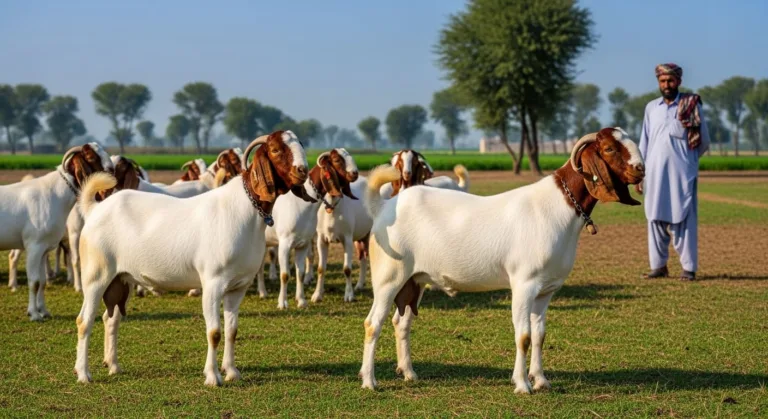
Have you ever seen a goat that looks like it’s been hitting the gym? That’s probably a Boer goat! These muscular, sturdy animals are making waves across Pakistan, and farmers everywhere are starting to take notice. Unlike the regular goats you might see wandering around your neighborhood, Boer goats look like the bodybuilders of the goat world, with their distinctive brown heads and white bodies.
In Pakistan, especially in regions like Multan and Punjab, farming communities are discovering something exciting. These South African goats aren’t just cool to look at, they’re actually changing the way people think about goat farming. Whether you’re interested in farming, curious about animals, or just want to understand why everyone’s talking about these special goats, you’re in the right place.
Let’s explore why Boer goats are becoming such a big deal in Pakistan, what makes them different from other goats, and how they’re helping farmers earn better incomes while providing quality meat for families across the country.
What Makes Boer Goats So Special?
Imagine if you could choose between a regular bicycle and a super-charged electric bike that goes twice as fast with less effort. That’s kind of what Boer goats are to traditional goat breeds! These animals were specially bred in South Africa during the early 1900s to be meat-producing machines.
Boer goats are known for their impressive size and rapid growth. While a regular Pakistani goat might weigh around 40-50 kilograms when fully grown, a Boer goat can easily reach 100-135 kilograms! That’s like comparing a lightweight backpack to a heavy suitcase. The males, called bucks, are even more massive and can tip the scales at over 150 kilograms.
What really sets them apart is how quickly they grow. A Boer goat kid can gain weight incredibly fast, reaching market size in just 6-8 months. Compare that to traditional breeds that might take 12-18 months to reach the same weight. For farmers, this means less time feeding the animals and quicker returns on their investment. It’s like planting a tree that grows twice as fast as normal trees, pretty amazing, right?
Why Pakistani Farmers Are Choosing Boer Goats
Pakistan has a long history of goat farming, with millions of goats raised across the country. So why are farmers suddenly interested in bringing in a foreign breed? The answer comes down to three important words: profit, efficiency, and quality.
First, let’s talk about profit. In cities like Multan, Lahore, and Karachi, there’s a huge demand for quality meat. Boer goats produce more meat per animal, which means farmers can earn more money from each goat they raise. During festivals like Eid-ul-Adha, when families sacrifice animals, Boer goats are becoming increasingly popular because of their size and meat quality.
Second, there’s efficiency. Pakistani farmers are smart business people. They’ve noticed that Boer goats can survive on the same types of food that local goats eat, things like grass, leaves, and agricultural waste. But here’s the cool part: Boer goats convert that food into body weight much more efficiently. It’s like having a car that gives you better mileage on the same amount of fuel.
Third, quality matters. Boer goat meat is known for being tender and flavorful. It has less fat compared to some other breeds, which is exactly what health-conscious consumers are looking for. Restaurants and butcher shops are willing to pay premium prices for Boer goat meat, which means more money in farmers’ pockets.
How Do Boer Goats Handle Pakistan’s Climate?
You might be wondering, “If Boer goats come from South Africa, can they really survive in Pakistan’s hot summers and cold winters?” It’s a great question! Think of Boer goats as adaptable travelers who can adjust to new environments pretty well.
Pakistan’s climate varies quite a bit depending on where you are. In Punjab, where places like Multanfarms.com operate, summers can be scorching hot, with temperatures soaring above 40 degrees Celsius. Winters, on the other hand, can get quite chilly. The good news? Boer goats are surprisingly tough.
These goats have a natural resistance to many diseases that affect local breeds. They also have a thick hide that protects them from both sun and cold. However, farmers do need to provide some basic care. During extreme summer heat, Boer goats need plenty of shade and fresh water. A simple roof made of straw or tin sheets can make a huge difference. During winter, while they don’t need heated barns like some fancy animals, they do appreciate a dry, draft-free shelter.
In areas like Multan and southern Punjab, where the climate is generally warm and dry, Boer goats actually thrive quite well. The moderate winters and hot summers are similar enough to parts of South Africa that these goats feel right at home.
The Economics of Raising Boer Goats
Let’s talk money, because that’s what really matters to farmers trying to support their families. Starting a Boer goat farm requires some initial investment, but the returns can be impressive.
A purebred Boer goat in Pakistan can cost anywhere from PKR 50,000 to 150,000 or more, depending on the quality and pedigree. That might sound like a lot, but think of it as an investment that keeps giving back. A healthy female Boer goat can have kids (baby goats) twice a year, usually producing twins or even triplets. Within a few years, one goat can turn into a whole herd!
Here’s where the math gets interesting. If you start with just three female Boer goats and one male, and each female produces two kids per year, you could have over 20 goats within three years. Each of those goats, when fully grown, could sell for anywhere from PKR 40,000 to 100,000 during peak seasons. Some prize animals sell for even more!
The costs of raising Boer goats include food (mostly grass and fodder), basic veterinary care, and shelter. Many Pakistani farmers are finding that Boer goats can graze on land that isn’t suitable for crops, making efficient use of resources. Farms like those in Multan often combine traditional farming with Boer goat raising, creating multiple income streams.
Challenges and Solutions for Boer Goat Farming
Like anything worth doing, raising Boer goats comes with some challenges. But here’s the thing: every challenge has a solution, and Pakistani farmers are proving to be incredibly innovative.
Challenge #1: Finding Quality Breeding Stock Not all Boer goats are created equal. Some sellers try to pass off mixed breeds as purebred Boers. The solution? Work with reputable farms like Multanfarms.com that have proper documentation and breeding records. It’s like buying a smartphone, you want to make sure you’re getting the real deal, not a knockoff.
Challenge #2: Learning New Techniques Traditional goat herders might not know all the specific care requirements of Boer goats. That’s where education comes in. Many successful farms offer training and support to new Boer goat owners. There are also online communities and agricultural extension services that share information.
Challenge #3: Managing Health Issues While Boer goats are generally healthy, they can still get sick if not properly cared for. Regular vaccinations, deworming, and hoof trimming are essential. Many farmers are learning to do basic care themselves while keeping a good veterinarian’s number handy for serious issues.
Challenge #4: Marketing Your Goats Finding buyers who appreciate quality and are willing to pay fair prices can be tricky. Smart farmers are using social media, connecting with restaurants and butcher shops, and building reputations for quality animals. Word-of-mouth marketing is incredibly powerful in Pakistan’s farming communities.
The Future of Boer Goats in Pakistan
So, what does the future hold for Boer goats in Pakistan? If current trends continue, we’re likely to see even more farmers adopting these animals. The Pakistani government is also starting to recognize the potential of improved livestock breeds, offering some support programs for farmers who want to upgrade their herds.
Young people in farming families are getting excited about Boer goats because they see them as a modern, profitable farming option. Instead of leaving farms to work in cities, some young Pakistanis are staying home to build successful Boer goat businesses. They’re using smartphones to research best practices, connect with buyers, and even market their animals online.
Agricultural experts predict that as more farmers gain experience with Boer goats, Pakistan could eventually start exporting breeding stock to neighboring countries. Imagine that, Pakistan becoming known not just for its traditional livestock, but also as a center for quality Boer goat breeding in South Asia!
Boer goats are more than just animals with fancy brown and white coloring. They represent an opportunity for Pakistani farmers to improve their livelihoods while providing better quality meat to consumers. From the farms of Multan to markets across Pakistan, these remarkable goats are proving that sometimes, bringing in new ideas from around the world can create amazing opportunities at home.
Whether you’re thinking about farming as a career, interested in where your food comes from, or just fascinated by animals, the story of Boer goats in Pakistan shows us something important. Success often comes from being willing to learn new things, adapt to changes, and work hard to make improvements.
What do you think? Could you see yourself as a Boer goat farmer someday, or do you know someone in your community who might benefit from learning about these incredible animals?