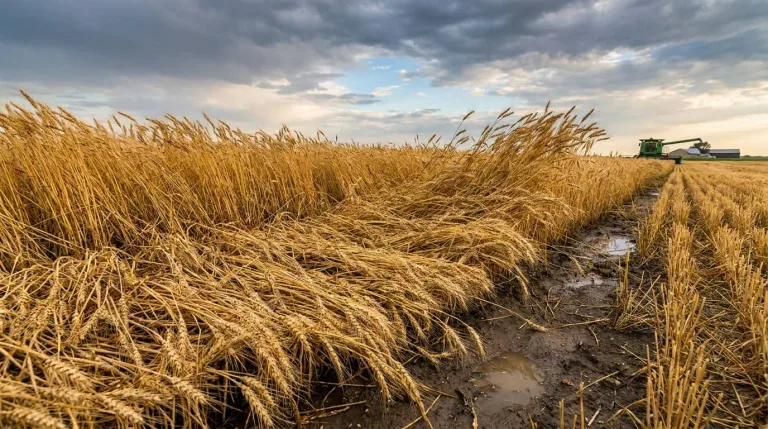
Imagine spending months planting, watering, and caring for a crop, only to walk into your field one morning and find thousands of wheat plants lying flat on the ground like a toppled crowd. That’s exactly what farmers across Punjab face when their wheat crop “lodges,” and it’s one of the most frustrating problems in grain farming. If you’ve ever seen a wheat field where entire sections are bent sideways or completely flat, you’ve witnessed lodging in action. Lodged wheat doesn’t just look bad. It can wipe out a significant portion of a farmer’s harvest, turning what started as a promising season into a financial crisis. Understanding why wheat lodges, what it does to the crop, and how farmers fight back is a story that connects every chapati on your table to the challenging daily reality of agriculture in Pakistan.
What Exactly Is Lodged Wheat?
Wheat lodging is the term farmers use when wheat plants fall over or tilt permanently before they’ve been harvested. Unlike a plant that bends in the breeze and springs back upright, a lodged plant stays down. It’s the agricultural equivalent of a tower of building blocks that’s been knocked over with no way to stand back up on its own. There are two main types of lodging. Stem lodging happens when the plant’s stalk buckles and breaks under pressure, much like a pencil snapping under too much force. Root lodging happens when the roots lose their grip on the soil and the entire plant tips over from the base, like a fence post pulled loose from soft ground. Both types cause the same devastating outcome: the plant is down, sunlight can no longer reach it properly, and the grain-filling process is severely disrupted.
What Causes Wheat to Lodge?
Several factors combine to push wheat plants past their breaking point. The most common trigger is a combination of strong wind and heavy rain. When a storm rolls through a fully grown wheat field, the weight of wet, rain-soaked grain heads sitting on top of long, slender stalks creates enormous downward pressure. Think of it like trying to balance a heavy water balloon on a thin drinking straw. Eventually, something has to give. Overfertilization with nitrogen is another major cause. Nitrogen encourages rapid, lush growth, which sounds like a good thing at first. But when plants grow too tall too quickly, their stems don’t develop the thick cell walls and strong fibers needed to stay upright. A farmer who applies too much nitrogen ends up with tall, weak-stemmed wheat that buckles the moment a storm arrives. Dense sowing adds to the problem. When seeds are planted too close together, plants compete intensely for light and grow taller and thinner in their effort to reach the sun above their neighbors. Taller plants with thinner stems are far more vulnerable to lodging than shorter, sturdier ones. These three factors, wind, excess nitrogen, and overcrowding, often work together to bring an entire crop to the ground.
How Lodging Destroys the Harvest
When wheat lodges, the damage goes far beyond what the eye can see. The grain heads are now sitting close to the soil surface, where moisture from the ground and ongoing rainfall keeps them persistently damp. This creates ideal conditions for fungal diseases like mold and ear blight to attack the developing grain. Infected grain shrivels, loses weight, and may become completely unfit for milling. Lodged wheat also blocks sunlight from reaching the lower leaves of the plant. Wheat uses sunlight to produce energy through photosynthesis, the same process that keeps all green plants alive and growing. Less sunlight means less energy, which directly reduces the size and weight of each grain. Research shows that severe lodging can cut wheat yields by anywhere from 30 to 80 percent, a staggering loss that can push a farming family from profit into serious debt in a single season. Harvesting lodged wheat adds yet another layer of difficulty. Combine harvesters are designed to gather upright plants cleanly and efficiently. When wheat is lying flat or tangled on the ground, the machinery struggles to pick it up, leaving significant quantities of grain behind in the field and adding to the overall loss.
Varieties That Stand Their Ground
One of the most effective defenses against lodging is choosing the right wheat variety before you even begin planting. Plant scientists have developed short-strawed wheat varieties specifically because shorter plants have a lower center of gravity and are far harder to knock over. This is the same principle that makes a low-slung sports car more stable around sharp corners than a tall, top-heavy vehicle. Pakistan’s agricultural research institutes, including NARC and the Wheat Research Institute in Faisalabad, have developed lodging-resistant varieties suited to the growing conditions of Punjab and Sindh. These varieties maintain thick, compact stems even when grown with generous applications of fertilizer. Choosing the right seed variety is essentially the first and most important line of defense a farmer has against lodging, before a single grain of wheat ever touches the soil.
How Farmers Fight Back Against Lodging
Beyond seed selection, farmers have several practical tools to reduce lodging risk throughout the growing season. Plant growth regulators (PGRs) are chemicals that slow down stem elongation without harming the plant’s overall development or yield potential. They essentially send the wheat plant a signal to stay short and build strength rather than height. PGRs are widely used in high-yielding farming systems around the world and have proven highly effective at keeping crops upright through difficult weather. Careful fertilizer management is equally important. Applying nitrogen in split doses across the growing season, rather than all at once at planting, gives plants time to develop strong structural tissues alongside their leafy growth. Soil testing before sowing helps farmers understand exactly how much nitrogen their specific fields actually need, preventing the over-application that creates those dangerously tall, weak stems. Adjusting sowing density ensures plants have enough room to develop without competing aggressively for light. Well-spaced wheat grows with thicker, sturdier stems, and that structural strength is ultimately what keeps a crop standing tall through the storms that arrive every rabi season.
From the Field to Your Table
Wheat is the backbone of Pakistan’s food supply. Every kilogram of flour, every roti, every biscuit starts its journey in a field where a farmer made hundreds of careful decisions to bring healthy grain to harvest. Lodging is one of the most persistent threats standing between that field and your kitchen, and understanding it helps explain why farming is as much a science as it is a skill passed down through generations. The next time you see a wheat field stretching across the flat plains of Punjab, take a moment to appreciate how much knowledge, preparation, and daily effort goes into keeping those plants standing upright, all the way from sowing to the moment the harvest begins.
For more articles on wheat farming, Pakistani agriculture, and the story behind your food, visit Multanfarms.com.