Have you ever eaten a juicy mango on a hot summer day and wondered where that delicious fruit came from? Before a mango reaches your plate, it begins its life on a tree that can grow surprisingly large and live for many years. The mango tree isn’t just a source of tasty fruit, it’s an amazing part of nature.
There are many fascinating facts about mango trees, from their long lives and evergreen leaves to the way their flowers turn into delicious mangoes. Let’s explore how mango trees grow, where they came from, why they’re important, and what makes them so special.
Where Did Mango Trees Come From?
One of the most interesting facts about mango trees is that they have a very long history. Mangoes are believed to have originated in South Asia, especially around areas of present-day India and nearby regions. From there, people carried mango plants and seeds to other warm parts of the world.
Today, mango trees grow in many tropical and subtropical countries. Pakistan, India, Bangladesh, Thailand, Indonesia, the Philippines, and several African and American countries all produce mangoes.
Think of the mango as a world traveler. It started in South Asia and eventually found homes in warm regions across the globe.
Pakistan is especially famous for mango production. Punjab and Sindh are important mango-growing areas, with popular varieties such as Chaunsa, Sindhri, Anwar Ratol, and Dussehri.
How Does a Mango Tree Grow?
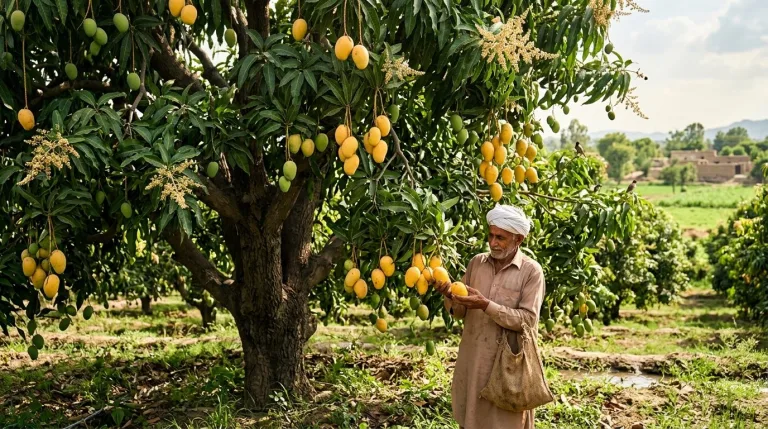
Mango trees need the right combination of sunlight, warmth, water, and suitable soil to grow well. They generally perform best in warm climates, which is one reason mango farming is important in parts of Pakistan.
A mango tree can grow much bigger than the small plant you might imagine. Depending on its variety and growing conditions, a mature mango tree can reach a height of around 10 to 40 meters.
Imagine planting a tiny mango seed and watching it eventually become a tree taller than a house. That’s quite a transformation!
Mango trees also have evergreen leaves, meaning they don’t normally lose all their leaves during one particular season. Their leaves can stay green throughout much of the year, helping the tree capture sunlight for photosynthesis.
Photosynthesis is the process plants use to make their own food from sunlight, water, and carbon dioxide. You can think of leaves as tiny solar panels that help power the tree.
How Does a Mango Become a Fruit?
Here’s another fascinating fact about mango trees, the mango you eat starts with a flower.
Mango trees produce clusters of small flowers. Some of these flowers are pollinated, meaning pollen reaches the part of the flower needed for reproduction. After successful pollination, certain flowers can develop into young mango fruits.
At first, the fruit is tiny and green. As it grows, it becomes larger and eventually develops the color, smell, softness, and flavor associated with its particular variety.
It’s similar to watching a small balloon slowly inflate. The young mango starts tiny, then gradually grows until it’s ready to harvest.
Weather and insects can also play important roles in this process. Bees and other insects may visit mango flowers while searching for food, and their movement can help transfer pollen between flowers.
Why Are Mango Trees So Important in Pakistan?
Mango trees are important for much more than providing a delicious summer snack. They support farmers, workers, businesses, and local markets.
Pakistan produces many varieties of mangoes, and mango farming provides income for people involved in growing, harvesting, packing, transporting, and selling the fruit.
Imagine one mango traveling from a farm to your kitchen. A farmer grows it, workers may harvest and sort it, someone packs it, a transport company carries it, and a shop or online seller eventually offers it to customers.
That means one mango can be connected to many different jobs.
Mangoes are also part of Pakistani food culture. During summer, families often enjoy fresh mangoes, mango shakes, juices, desserts, and other mango-based foods.
What Makes Mango Trees Special?
There are plenty of fascinating facts about mango trees that make them stand out from many other fruit trees.
1. Some Mango Trees Can Live for Decades
Mango trees can have long lives when they receive proper care and grow in suitable conditions. Some trees can remain productive for many years.
That’s like having a family member who stays around for generations, except this family member produces mangoes!
2. Mango Trees Can Become Very Large
A mature mango tree can develop a broad canopy, with branches spreading outward and creating plenty of shade.
On a hot afternoon, sitting under a large mango tree can feel much cooler than standing directly under the sun.
3. Mango Varieties Taste Different
Not all mangoes taste the same. Some are very sweet, some have a stronger aroma, and others have a softer or firmer texture.
For example:
- Chaunsa is famous for its sweetness and strong aroma.
- Sindhri is known for its large size and sweet flavor.
- Anwar Ratol is a smaller mango that many people love for its rich taste.
- Dussehri is another popular variety known for its sweet pulp.
It’s a little like comparing different types of apples. They’re all apples, but each variety has its own flavor and texture.
4. Mango Trees Provide More Than Fruit
A mature mango tree can provide shade and shelter for birds and insects. Its branches and leaves become part of the local ecosystem.
Trees also help absorb carbon dioxide from the atmosphere and release oxygen through photosynthesis. Their roots can help hold soil together as well.
What Does a Mango Tree Need to Stay Healthy?
Growing a mango tree isn’t as simple as planting a seed and forgetting about it. Farmers need to give trees proper care.
Here are some important needs:
- Sunlight: Mango trees grow best when they receive plenty of sunlight.
- Water: Young trees need regular watering, while mature trees have different water needs depending on weather and soil.
- Good soil: Soil should provide enough nutrients and allow excess water to drain properly.
- Space: Mango trees need room for their roots and branches to develop.
- Pest protection: Farmers need to watch for insects and diseases that can damage leaves, flowers, or fruit.
- Pruning: Carefully removing selected branches can help manage the tree’s shape and growth.
Think about taking care of a pet. You provide food, water, shelter, and attention because each one matters. A mango tree also needs regular care to stay healthy.
Did You Know These Mango Tree Facts?
Here are a few quick facts to remember:
- Mango trees belong to the Anacardiaceae family, the same plant family that includes cashews.
- Mango is a tropical and subtropical fruit that grows best in warm conditions.
- Mango trees can become very large if they’re allowed to grow naturally.
- Mango fruit develops from flowers after successful pollination.
- Mango varieties can differ greatly in size, color, flavor, aroma, and texture.
- Pakistan is well known for varieties including Chaunsa, Sindhri, Anwar Ratol, and Dussehri.
- Mango trees can provide food, shade, habitat, and economic value.
Why Should We Care About Mango Trees?
Mango trees show us how connected nature, farming, food, and people really are. A mango doesn’t simply appear at a market. It begins with a tree, sunlight, water, flowers, pollination, careful farming, harvesting, and transportation.
The next time you enjoy a sweet mango, take a moment to think about the journey behind it. From a flowering tree in a warm orchard to the fruit in your hands, there’s a whole story hiding inside every mango.
So, which mango variety would you choose if you could pick one straight from a tree, Chaunsa, Sindhri, Anwar Ratol, or Dussehri?