Pakistan consumes millions of tonnes of fish every year, yet a large portion of that demand is still met through imports or overfished natural water bodies. Meanwhile, thousands of farmers across the country are sitting on a simple but powerful opportunity they’ve barely tapped. Biofloc fish farming is changing the way aquaculture works around the world, and it’s quietly gaining ground in Pakistan too. If you’ve never heard of it, by the end of this article you’ll understand exactly why it matters and why more Pakistani farmers are making the switch.
Traditional fish farming works well on large ponds with plenty of land and fresh water. But land is expensive, water is increasingly scarce, and conventional ponds struggle to produce fish at the density modern demand requires. Biofloc technology flips that model on its head. It lets you raise fish in compact tanks, use the same water for months, and dramatically cut feed costs, all at the same time.
What Is Biofloc Technology, and Why Is Everyone Talking About It?
Biofloc technology (BFT) is a method of fish farming that harnesses naturally occurring microorganisms, including bacteria, algae, fungi, and tiny zooplankton, to clean the water and feed the fish simultaneously. These microorganisms form small clusters suspended in the water called flocs, which look like tiny living particles floating through the tank.
Here’s what makes this remarkable. In a conventional fish tank, fish waste releases ammonia into the water, which is toxic and needs constant fresh water exchange to dilute. In a biofloc system, beneficial bacteria convert that ammonia into protein-rich microbial biomass. The fish then eat those flocs as supplementary feed, turning their own waste into nutrition. It’s essentially a self-cleaning, self-feeding loop built right inside the tank.
Think of it like a composting system for kitchen waste, except the compost is alive, nutritious, and gets eaten directly by the fish you’re raising. Nothing is wasted, and the system becomes more efficient the longer it runs.
How the Biofloc System Actually Works
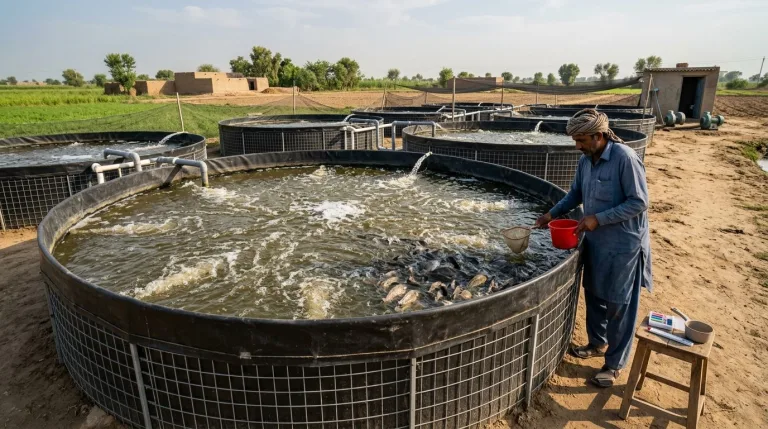
A basic biofloc setup consists of a round or rectangular tank, usually two to five metres in diameter, with a depth of around one to one-and-a-half metres. The most critical piece of equipment is the aeration system, which keeps the water constantly circulating through paddlewheel aerators or air blowers. Without continuous aeration, the flocs sink and the system can crash within hours.
To get the microbial community started, farmers add a carbon source, usually molasses, along with probiotic cultures. This feeds the bacteria and jumpstarts floc formation. The water gradually turns greenish-brown over the following days, which is actually a sign the system is working correctly.
The key variable to manage is the carbon-to-nitrogen ratio (C:N ratio). When fish are fed, they release nitrogen as ammonia. Adding carbon through molasses keeps the bacteria converting that ammonia before it reaches dangerous levels. Monitoring this ratio, along with dissolved oxygen and pH, is what separates a successful biofloc farm from a failed one.
Why Biofloc Fish Farming Makes Perfect Sense in Pakistan
Pakistan faces a specific set of agricultural challenges. Water scarcity is worsening across Punjab, Sindh, and Balochistan. Land prices near urban centres are out of reach for most small farmers. And the cost of commercial fish feed keeps climbing, eating into profit margins for traditional fish farmers.
Biofloc directly addresses all three problems at once. A well-run biofloc system uses up to 90% less water than a traditional earthen pond because water is recycled rather than exchanged. The same volume of water that might support fifty fish in a pond can support two hundred or more in a biofloc tank. And because the fish feed on flocs as a protein supplement, farmers typically see a 20 to 40 percent reduction in feed costs, which is significant given that feed represents the largest operating expense in fish farming.
For farmers in water-stressed areas like South Punjab and Thal region, this isn’t just an improvement. It’s a genuine lifeline that makes fish farming viable where it previously wasn’t possible.
Which Fish Species Work Best in Biofloc Systems in Pakistan?
Not every fish thrives in the dense, microbe-rich environment of a biofloc tank. The species you choose has a major impact on how smoothly the system runs and how quickly you recover your investment.
Tilapia is the most widely used species in biofloc systems globally, and for good reason. It tolerates high stocking densities, actively grazes on flocs, and grows to marketable size in four to six months. Pakistan’s climate, particularly in southern Punjab and Sindh, suits tilapia perfectly given its preference for warmer water above 25°C.
Rohu is a local favourite that performs well in biofloc systems and commands strong market prices across Pakistani cities. It’s a culturally familiar fish that consumers already trust, which makes it easier to sell directly to local markets.
Catfish, including Pangasius, has also shown strong results in biofloc environments. It’s hardy, an efficient feed converter, and grows rapidly, making it a practical choice for farmers focused on fast production cycles.
What Does It Cost to Start a Biofloc Farm in Pakistan?
A basic single-tank biofloc setup in Pakistan can be started for as little as PKR 150,000 to 250,000, depending on tank size and aeration equipment. Tarpaulin tanks are the most popular entry point because they’re affordable, portable, and require no construction.
The ongoing costs include electricity for the aerators, feed, molasses, and probiotics. Power availability is one of the most important practical considerations. Farms in areas with frequent load-shedding need a backup generator or solar-powered aeration to avoid losses during outages. Many successful biofloc farmers in Pakistan started with a single 10,000-litre tank, ran one production cycle to learn the system, and then expanded once they were confident in the management routine.
Common Challenges and How to Overcome Them
Biofloc farming requires consistent attention. Small errors in water quality management can cause rapid deterioration if left unchecked.
The most common challenge is excessive suspended solids as flocs multiply. When floc volume gets too high, it stresses the fish and reduces oxygen availability. Experienced farmers manage this by removing a portion of the floc-rich water periodically and replacing it with fresh water to maintain the right balance.
Several agricultural universities and fisheries departments in Punjab and Sindh now offer short courses and working demonstrations for interested farmers. Visiting an operational biofloc setup before committing your own capital is one of the smartest moves you can make.
Biofloc Is Rewriting the Rules of Fish Farming in Pakistan
The demand for affordable, locally farmed fish in Pakistan is only going to grow as the population rises and food consumption patterns shift. Biofloc technology gives farmers the tools to meet that demand without relying on large tracts of land, abundant fresh water, or expensive feed.
It rewards careful management over heavy investment, which suits small and medium-scale Pakistani farmers well. Whether you’re planning a single tank or a serious multi-tank setup, biofloc offers a genuinely viable path forward.
For more practical guidance on fish farming, crop management, and agricultural practices rooted in Pakistan’s conditions, visit Multanfarms.com.