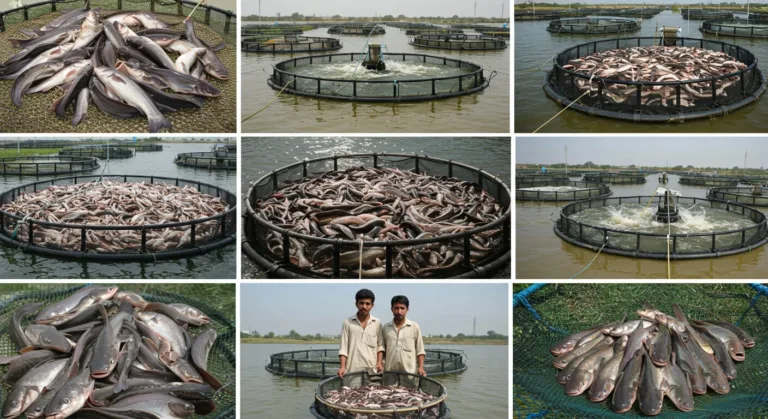
Imagine having your own underwater ranch where instead of cows and sheep, you’re raising thousands of fish swimming around in perfectly controlled ponds! That’s exactly what fish farmers in Pakistan do every day, and it’s one of the coolest ways to produce food you’ve probably never thought about. While you might think all fish come from rivers, seas, or lakes, many of the fish on dinner tables across Pakistan actually come from carefully designed fish farms.
Pakistan is blessed with incredible water resources, from the mighty Indus River to the Arabian Sea coastline, making it perfect for both catching wild fish and farming them. Aquaculture production has rapidly increased since 2000 from around 10-15 thousands tonnes to reach over 100,000 tonnes in 2006 and 2007, which means fish farming in Pakistan has grown faster than a teenager during a growth spurt!
By the time you finish reading this article, you’ll understand how fish farming works in Pakistan, why it’s becoming so important for feeding families, and how farmers are turning simple ponds into amazing underwater food factories. Get ready to dive into the fascinating world of Pakistani aquaculture!
Pakistan’s Fish Farming Superstars: Meet the Champions
Just like how different crops grow best in different seasons, Pakistan farms specific types of fish that absolutely love the local climate and water conditions. The most important freshwater culturable fishes of Pakistan are the “major Indian carps like ‘Rohu’ (Labeo rohita), ‘Thaila’ (Catla catla) and ‘Mori’ (Cirrhina mrigala). These aren’t just random fish names, these are the rock stars of Pakistani fish farming!
Think of these three fish as the perfect roommates who never fight over food. Major carps are the best example of a polyculture system because they do not compete with one another for food i.e. Catla get their food at the surface layer, Rohu from the midlayer and mrigal at the bottom of the pond. It’s like having one friend who only eats from the top shelf, another from the middle shelf, and a third from the bottom shelf, everyone gets fed without any arguments!
Rohu is probably the most popular fish in Pakistani fish farms. Adults can reach a maximum weight of 45 kg (99 lb) and maximum length of 2 m (6.6 ft), but average around 1⁄2 m (1.6 ft). That’s like having a fish that could be as long as you are tall! Catla is the speed demon of the group, Catla is the fastest growing Indian major carp species, making it a favorite among farmers who want quick results.
What’s really cool is that only seven warm water species and two cold water species are cultivated on a commercial scale in Pakistan, which means farmers have figured out exactly which fish work best in their climate and stick with the winners.
From Tiny Ponds to Major Operations: How Fish Farming Actually Works
Fish farming in Pakistan isn’t just about digging a hole and filling it with water. In Pakistan, there are various forms of fish aquaculture, including: Pond Culture: Common method, raising fish in controlled ponds. Cage Culture: Fish farmed in submerged cages in natural water bodies. Integrated Rice-Fish Farming: Simultaneous growth of fish and rice, providing dual income streams. It’s like having different types of apartments for fish, each designed for different needs and situations.
Pond culture is the most common method, kind of like having a backyard swimming pool but designed for fish instead of people. Farmers carefully design these ponds with the right depth, water flow, and feeding systems to create the perfect fish paradise.
Cage culture is like having underwater apartments floating in rivers or lakes. The fish live in secure cages that protect them from predators while still letting them enjoy natural water conditions. It’s similar to how you might keep a pet hamster in a cage, except these “cages” are huge and underwater.
The coolest method might be integrated rice-fish farming, where farmers grow rice and raise fish in the same flooded fields! The rice plants provide shade and oxygen for the fish, while the fish provide natural fertilizer for the rice. It’s like having a perfect partnership where everyone helps everyone else succeed.
The species combination stocked in fish ponds of fish were Silver Carp 35%, Rohu 25%, Grass Carp 15%, Mori/Gulfam 20% and additional 5% of channel catfish were added. This precise mixing is like creating the perfect recipe, each type of fish plays a specific role in making the whole pond system work efficiently.
The Science Behind Success: Why Pakistani Fish Farms Work So Well
The warm waters and varied coastline of Pakistan are an ideal environment for a variety of fish species, making it well-suited for both marine and freshwater fish farming. It’s like Pakistan won the geographic lottery when it comes to fish farming conditions!
Pakistani fish farmers have become incredibly smart about maximizing their production. The data indicated that the production level was better at high stocking density @ 2100 fish/acre i.e. 2054 kg/acre with artificial feeding. This means farmers have figured out exactly how many fish can live comfortably in each pond while still producing the maximum amount of food.
The feeding strategy is crucial too. These fish are herbivorous in nature and are very selective about their food, which means farmers need to provide the right types of plant-based food to keep their fish healthy and growing quickly. It’s like being a nutritionist for thousands of underwater pets!
What makes Pakistani fish farming even more impressive is that despite its vast fresh, brackish and marine water resources only carp culture is practiced in ponds, showing how farmers have specialized in what works best rather than trying to do everything at once.
From Small Beginnings to Big Business: The Growth Story
The growth of fish farming in Pakistan is like watching a small seed grow into a giant tree. Despite facing challenges, such as limited access to credit and a lack of infrastructure, the industry has seen significant growth in recent years and is considered a key contributor to food security in Pakistan. This shows how determined Pakistani farmers are to succeed even when things get difficult.
The government has made significant efforts to promote the aquaculture sector, recognizing its potential to provide economic growth and food security. It’s like having your school principal, teachers, and parents all working together to help you succeed in your favorite subject.
The business side is pretty amazing too. It is considered to be one of the best business ideas in Pakistan, which means smart entrepreneurs are seeing fish farming as a great way to make a living while feeding their communities. Commercial Fishing: Large-scale, marine fish-focused operations for export fish types and local markets. Artisanal Fishing: Small-scale, traditional operations catering to local communities shows how there’s room for both big companies and small family operations.
What’s really encouraging is that aquaculture has also received a substantial amount of government investment, and facilities are now in place, meaning the infrastructure is getting better and better for fish farmers to succeed.
Feeding Pakistan: Why Fish Farms Matter More Than Ever
With a growing population and, thus, an increase in demand, fish farming has the potential to boost the economy to a greater degree. This is like having a solution that gets better and more important as more people need it, which is exactly what Pakistan needs.
Fish farming isn’t just about making money, it’s about food security. When you have fish farms producing thousands of tons of fresh protein every year, it means families across Pakistan can have access to nutritious, affordable food. Fish is packed with protein, healthy fats, and vitamins that help people grow strong and stay healthy.
The environmental benefits are pretty cool too. Fish farms use much less land than cattle ranching to produce the same amount of protein. It’s like getting more bang for your buck while being kinder to the environment. Plus, many fish farms actually help clean the water they’re in because the fish eat algae and other organic matter.
Fish farming also creates jobs in rural areas where there might not be many other opportunities. From pond construction to fish processing to transportation, one fish farm can provide work for dozens of families in a community.
Challenges and Future Dreams: Where Fish Farming is Heading
Even though Pakistan’s fish farming industry is growing fast, it still faces some challenges that make it like a video game where you have to overcome obstacles to reach the next level. Despite facing challenges, such as limited access to credit and a lack of infrastructure, farmers are finding creative solutions.
The good news is that by categorizing fish farms into specific groups, we can tailor aquaculture policies to address the unique challenges and opportunities of each category, ensuring a more sustainable and productive aquaculture industry. This means the government and experts are working together to create custom solutions for different types of fish farms.
Technology is also helping Pakistani fish farmers become more efficient. New feeding systems, water quality monitoring, and breeding techniques are making it possible to produce more fish with less effort and resources.
The future looks incredibly bright for Pakistani fish farming. As more people learn about the benefits of eating fish and as farming techniques improve, this industry has the potential to become one of Pakistan’s major food production success stories.
Conclusion: Swimming Toward a Brighter Future
Fish farming in Pakistan represents something really special: it’s a perfect example of how humans can work with nature to create sustainable food systems that benefit everyone. From the clever three-layer feeding system of major carps to the innovative rice-fish farming combinations, Pakistani fish farmers are showing the world how to produce high-quality protein efficiently and sustainably.
The next time you see fish on your dinner plate, remember that it might have come from a carefully designed pond where farmers spent months nurturing it from a tiny fry to a healthy, nutritious meal. These fish farms represent thousands of jobs, millions of meals, and a growing industry that’s helping feed Pakistan’s future.
Have you ever thought about what it would be like to visit a fish farm and see thousands of fish swimming in perfectly organized ponds? What do you think would be the most interesting part of running a fish farm in Pakistan?