Fish farming is one of the fastest-growing agricultural ventures in Pakistan, and the timing has never been better to get into it. Wild fish stocks are under pressure, demand for affordable protein keeps rising, and Pakistani waterways, from Punjab’s canal networks to Sindh’s floodplains, provide near-ideal conditions for freshwater aquaculture. Whether you have half an acre of flat land or a larger agricultural plot, setting up a fish farm is genuinely achievable with the right preparation.
The challenge most new farmers face is not the work itself but knowing where to start and in what order. A fish farm needs the right species, the right water, a properly built pond, and a consistent management routine. Get those four things aligned and you have a system that pays back reliably year after year.
Choose Your Fish Species Before Anything Else
The single most important decision in fish farming happens before a single shovel of earth is moved. Your species choice determines stocking density, feeding costs, harvest timeline, and market price, so it deserves serious thought.
In Pakistan, rohu (Labeo rohita) and catla (Catla catla) are the most widely farmed freshwater species, and for good reason. Both grow fast, survive well in local conditions, and sell strongly at wholesale and retail markets. Grass carp and common carp are excellent polyculture partners because they occupy different levels of the water column and use different food sources, which reduces competition and maximises pond productivity.
Tilapia is worth considering if you have warmer water and want faster turnover. It tolerates a wide temperature range, reproduces readily, and has growing urban demand. Match your species selection to your water source, your climate, and where you plan to sell before moving forward.
Pick the Right Land and Confirm Your Water Supply
Fish ponds need flat land with clay-heavy soil. Clay holds water efficiently and keeps construction costs manageable. Sandy or gravelly soil drains too quickly, forcing constant refilling and making long-term management expensive. If your land is primarily sandy, clay lining is possible but adds significant cost to the build.
A reliable water source is non-negotiable. Canal water, tube wells, rivers, and natural springs all work, but the water must be clean and free from industrial runoff or chemical contamination. Test for pH, which should sit between 7 and 8.5 for most freshwater species, and check ammonia and dissolved oxygen levels before committing to a site. Poor water quality is the most common reason new fish farms underperform, and it is entirely avoidable with a basic test kit and a good supply line.
Build Ponds That Are Practical to Manage
A productive fish pond for small-scale farming typically sits between 0.1 and 0.5 acres in size and between 1.5 and 2 meters in depth. Shallow ponds overheat in summer, which stresses fish and reduces growth. Ponds deeper than 2.5 meters are harder to harvest and develop oxygen-poor layers near the bottom.
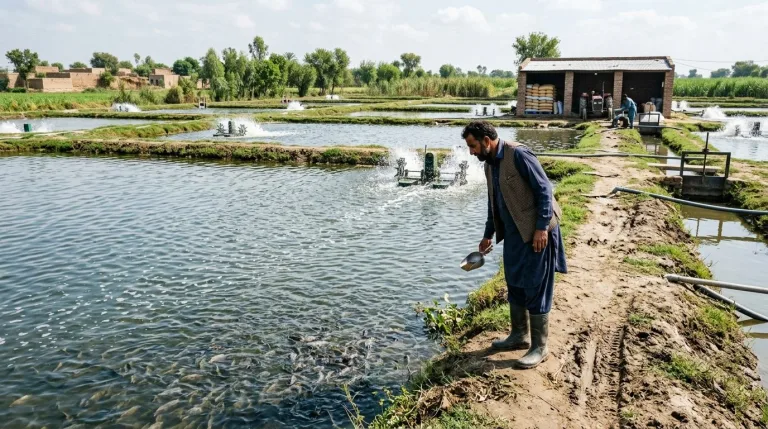
Every pond needs an inlet pipe for controlled filling and a drain or outlet for water changes, emergency drawdown, and harvest. Line the embankment slopes with grass to prevent erosion during rains. If you plan to stock at higher densities, invest in a paddle wheel aerator or similar device that keeps dissolved oxygen at safe levels around the clock, especially during hot nights when oxygen levels naturally drop.
Stock with Quality Fingerlings at the Right Density
Fingerlings are juvenile fish, typically 5 to 10 cm long, and sourcing them from a certified hatchery matters more than most first-time farmers realise. Hatchery-certified fingerlings are disease-screened, genetically consistent, and acclimatised for pond conditions. Buying cheap fingerlings of uncertain origin is one of the most common and costly mistakes in early fish farming.
For a standard polyculture pond, a reliable starting ratio is 40% rohu, 30% catla, and 30% common carp. Stocking at around 5,000 to 8,000 fingerlings per acre is typical for semi-intensive farming without aeration. With a functioning aerator and quality feed, that number can go higher. Introduce fingerlings during cooler parts of the day and acclimate the water temperature gradually to reduce shock losses.
Feed Correctly and Track What You Give
Fish in a managed pond cannot forage freely, so supplemental feeding is essential to achieving commercial growth rates. A standard feed mix for Pakistani freshwater farms combines rice bran, mustard oil cake, and formulated pellet feed. The general guideline is to feed 2 to 3% of estimated total fish body weight per day, split into two sessions, morning and late afternoon.
Overfeeding is as damaging as underfeeding. Uneaten feed sinks, decomposes, strips oxygen from the water, and creates ammonia build-up that directly harms fish health. Keep a daily feeding log, weigh batches periodically to estimate total biomass, and adjust feed quantities as fish grow through the season.
Manage Water Quality All the Way to Harvest
Water quality does not manage itself. Check pH, temperature, dissolved oxygen, and ammonia at least once a week, more often during summer peaks or after heavy rain. Agricultural lime applied to the dry pond bed before stocking stabilises pH and reduces pathogens in the soil, and it costs very little relative to the protection it provides.
Partial water exchanges of 20 to 30% every two to three weeks dilute waste concentration and refresh mineral balance. Run aerators through hot summer nights without exception. Fish that are oxygen-stressed eat poorly, grow slowly, and become susceptible to bacterial infections that can spread through an entire pond within days. Consistent water management is the difference between a fish farm that performs and one that limps.
Harvest at the Right Time and Sell Smart
Most commonly farmed Pakistani species reach marketable weight of 1 to 1.5 kg within 8 to 12 months under a proper feeding and management regime. Harvest by partially draining the pond and drawing fish toward the outlet using nets. Always harvest during the cooler morning hours to minimise stress on the fish and maximise freshness for transport.
Plan your timing around market demand. Eid seasons, local market peaks, and Ramadan are high-demand periods when prices are strongest. Selling directly to local fish markets, wholesale buyers, or restaurants consistently returns better margins than working through intermediaries. Consistent sizing and fresh handling are what build the repeat buyers every fish farm needs to stay profitable.
Fish farming rewards the farmer who prepares well and manages consistently. From species selection to water quality routines, each decision compounds into the final harvest weight and the price it commands.
For more practical guidance on Pakistani agricultural ventures, visit Multanfarms.com and explore resources built for farmers who take their results seriously.