Imagine turning a patch of empty land into a productive farm that harvests thousands of kilograms of fresh fish every year. No orchards to wait on, no crop diseases wiping out an entire season, and a product that sells fast in every city market across Pakistan. That’s the promise of fish farming, and it’s more achievable than most people think.
But getting it right starts with understanding what fish farming actually requires. Whether you’re a farmer considering diversification or someone completely new to aquaculture, knowing the basics upfront saves you time, money, and a lot of frustration. Let’s walk through everything you need.
The Right Land Is Your Foundation
Not every piece of land works for a fish farm, and choosing the wrong site is the most expensive mistake a beginner can make. The ideal location sits close to a reliable water source, whether that’s a canal, river, or tubewell. Flat or gently sloping land is best because it holds water evenly and makes pond construction straightforward.
Soil type matters enormously. Clay-heavy soil is what you want. Think of it like a natural bowl: clay holds water in place without constant seepage, which keeps your pond full and your fish alive. Sandy or gravelly soil lets water drain away quickly, making it nearly impossible to maintain proper pond levels without expensive lining.
Pond size can vary based on your budget and goals. Beginners typically start with ponds between 0.5 and 2 acres. Larger ponds produce more fish, but they also require more capital, more feed, and more active management. Starting small and scaling up is almost always the smarter approach.
Water Quality Is the Heart of Fish Farming
If land is your foundation, water quality is your heartbeat. Fish are completely dependent on their water for oxygen, temperature regulation, and waste removal. Get the water wrong, and even the healthiest fish won’t survive.
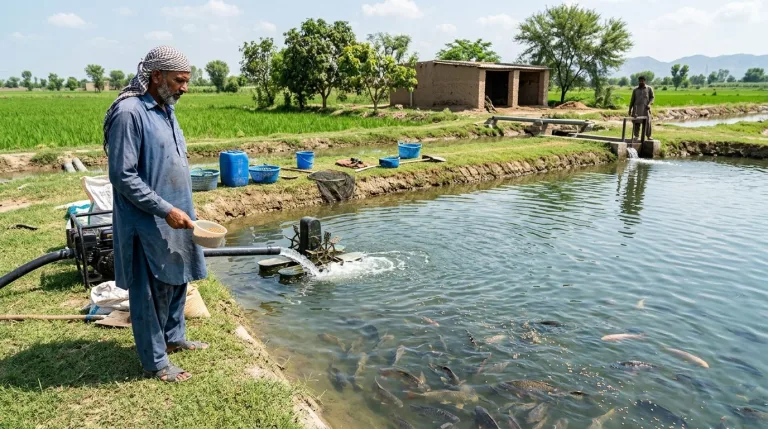
Dissolved oxygen (DO) is the most critical factor. Fish breathe oxygen dissolved in water, just like we breathe oxygen in air. Levels should stay above 5 mg/L at all times. In hot summer months, oxygen levels naturally drop, which is why many farms use mechanical aerators (devices that pump air into the water to keep oxygen levels stable).
pH levels should remain between 7 and 8.5 for most freshwater species farmed in Pakistan. A pH that’s too acidic or too alkaline stresses fish, slows their growth, and makes them vulnerable to disease. Farmers regularly test pH using simple kits and adjust it with lime if needed.
Water temperature is equally important. Common Pakistani fish species like Rohu and Catla thrive in water between 25°C and 32°C, which is why Punjab’s warm climate gives local farmers a natural advantage during peak growing months.
Choosing the Right Fish Species for Your Pond
One of the biggest fish farming requirements is selecting species that actually suit your local climate, water source, and target market. You can’t just stock any fish and expect strong results.
In Pakistan, most successful fish farms rely on a polyculture approach, stocking multiple species that feed at different levels of the pond. This is like packing a lunchbox with different foods, where nothing is wasted and every item serves a purpose. Common combinations include:
- Rohu: High market value, excellent taste, feeds in the middle water column
- Catla: Fast-growing surface feeder, reliable seller in urban markets
- Grass Carp: Eats aquatic weeds, naturally cleans the pond
- Silver Carp: Filters algae and plankton from the upper water layer
- Common Carp: Hardy and forgiving, ideal for new farmers
A typical stocking rate ranges from 5,000 to 10,000 fingerlings (juvenile fish, 2 to 5 cm in length) per acre, depending on the species mix and your water management capacity.
Feed and Daily Nutrition Management
Fish don’t just eat whatever floats past them, at least not on a productive farm. Proper fish feed management is one of the most important daily requirements of a successful operation.
Commercial fish pellets are the backbone of most feeding programs. They’re formulated to provide balanced protein, fat, and vitamins at each growth stage. Many farmers in Punjab also supplement with locally available materials like rice bran, mustard oil cake, and cottonseed meal, which brings feed costs down significantly.
Fish are typically fed twice a day, morning and evening, with daily feed amounts set at 2 to 5 percent of the total fish body weight in the pond. Overfeeding is just as harmful as underfeeding because uneaten feed decomposes and pollutes the water, dropping oxygen levels and triggering disease outbreaks.
Equipment Every Fish Farm Needs
You don’t need a warehouse full of machinery to run a fish farm, but a few key pieces of equipment are non-negotiable. Pond aeration equipment, specifically electric aerators or paddle wheel aerators, is essential for keeping oxygen levels healthy, especially through summer nights when heat stress peaks.
A reliable water pump is needed to top up pond levels as evaporation occurs and to manage water exchange when quality deteriorates. Simple water testing kits for pH and dissolved oxygen should be on hand at all times for daily monitoring. Most good farmers check their water first thing every morning, the same way you’d check your phone after waking up.
For harvest and fish health management, you’ll need seine nets (long fishing nets dragged through the pond) and basic disease treatment supplies like potassium permanganate and salt, both commonly used for parasite control. None of this is expensive, but skipping any of it creates problems that cost far more to fix.
Financial and Legal Requirements
Before you dig a single pond, understand the financial side clearly. Initial setup costs for a one-acre fish farm in Pakistan range from Rs. 80,000 to Rs. 1,50,000, covering land preparation, pond construction, fingerlings, feed for the first cycle, and basic equipment.
On the legal side, fish farming in Punjab requires registration with the Punjab Fisheries Department. This process is straightforward and comes with real benefits, including access to subsidized fingerlings, technical training, and advisory services from government extension officers. Skipping registration means skipping those support systems, which is a costly mistake for a first-time farmer.
Several banks and agricultural development programs also offer low-interest loans specifically designed for fish farmers. Exploring these options before committing your own capital is well worth the time.
You’re More Ready Than You Think
Fish farming has a reputation for being complicated, but the core requirements are actually quite manageable once you understand them. Good land, clean water, the right species, a solid feeding routine, basic equipment, and proper registration, that’s the complete picture.
Thousands of farmers across Punjab have started with a single pond and built it into a reliable second income. The knowledge gap is often the only real barrier, and you’ve already started closing it. What fish species would you stock first?
For more practical guides on Pakistani agriculture, fish farming, and rural business opportunities, visit Multanfarms.com. اصلی ذائقہ، اصلی علم۔