Did you know that every piece of food on your plate follows an invisible calendar? The wheat in your roti, the rice in your biryani, the sugar in your chai, all of it was planted and harvested at very specific times of the year, guided by a rhythm that Pakistani farmers have followed for thousands of years. That rhythm is built around crop seasons, and understanding them is the key to understanding how this country feeds over 200 million people.
Pakistan is one of the most important agricultural countries in Asia. Farming contributes roughly 20% to the national economy and keeps millions of families employed. But none of that would work without a clear system of when to grow what. So let’s break down Pakistan’s crop seasons in a way that actually makes sense.
Pakistan’s Two Main Crop Seasons: Kharif and Rabi
Pakistan’s agricultural calendar is divided into two major growing seasons, each one perfectly timed to take advantage of the country’s changing weather patterns.
The first is the Kharif season (also spelled Khareef), which runs roughly from April or May all the way to October or November. The word “Kharif” comes from Arabic and means “autumn,” because that’s when these crops are harvested. Kharif crops are planted when the heat is rising and the monsoon rains are on their way, so they thrive in warm, wet conditions.
The second is the Rabi season, which runs from October or November through to March or April. “Rabi” is an Arabic word meaning “spring,” and true to its name, Rabi crops are harvested in the spring after growing through the cooler winter months. These crops love cool weather and depend on winter rains and canal irrigation to survive.
Think of it like two shifts at a factory. While one team rests, the other is hard at work. The land is almost never completely idle.
Kharif Crops: When the Monsoon Does the Heavy Lifting
The Kharif season is the bigger and more dramatic of the two, largely because it coincides with Pakistan’s monsoon period. When the rains arrive, farmers across Punjab, Sindh, and KPK spring into action.
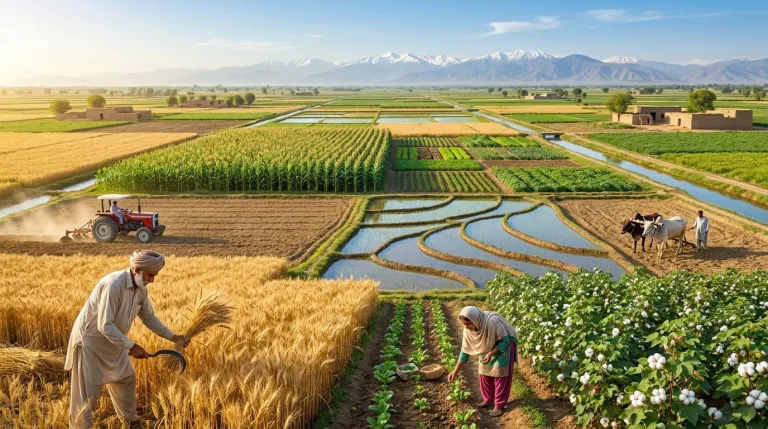
Rice is perhaps the most famous Kharif crop in Pakistan. The flooded paddies of Punjab and Sindh are iconic, and Pakistani varieties like Basmati are exported all over the world. Rice needs lots of water and warmth, making it a perfect monsoon crop.
Cotton is another Kharif giant and one of Pakistan’s most economically important crops. Pakistan is among the world’s top cotton producers, and most of that cotton is grown in Punjab and Sindh during the Kharif season. It goes on to feed the entire textile industry.
Other significant Kharif crops include sugarcane, maize (corn), mung beans, and sorghum. Each of these thrives in the heat and benefits from the monsoon rains that sweep across the country between July and September. When the rains are good, Kharif harvests can be spectacular. When they fail or arrive late, the damage can be enormous.
Rabi Crops: The Cool-Season Champions
Once the Kharif crops are harvested and the temperatures begin to drop, farmers prepare their fields for the Rabi season. This is when some of Pakistan’s most vital food crops take center stage.
Wheat is the undisputed king of the Rabi season. Pakistan is one of the world’s largest wheat producers, and wheat forms the backbone of the Pakistani diet. It’s sown from October to December and harvested in March and April. Almost every farm family in Punjab plants some wheat, whether they have five acres or five hundred.
Chickpea (gram) and lentils are also major Rabi crops. These pulses provide affordable protein to millions of households and are a staple of daal served across the country. Mustard, grown widely in Punjab, is another Rabi crop that produces the oil used in traditional cooking.
Barley is one of the oldest crops in human history and has been grown in this region for millennia. It’s still an important Rabi crop today, used for food, animal feed, and increasingly for commercial purposes. The Rabi season may be quieter than Kharif in terms of rainfall, but its crops are just as essential to daily life.
The Role of Irrigation in Making Both Seasons Possible
Here’s something remarkable about Pakistan’s agriculture. A large part of the country is quite dry, especially the vast plains of Punjab and Sindh. Without irrigation, neither the Kharif nor the Rabi season would be nearly as productive.
Pakistan has one of the largest canal irrigation systems in the world, a network of rivers, canals, and distributaries that channels water from the Indus River and its tributaries across millions of acres of farmland. This system is what turns semi-arid land into some of the most productive farmland in Asia.
During the Rabi season especially, when monsoon rains aren’t available, canal water and tube wells (underground pumps) become absolutely critical. Farmers time their sowings and their water requests around the canal schedule, and managing this resource well can make the difference between a good harvest and a poor one.
Why Crop Seasons Matter More Than Ever
With climate change increasingly affecting rainfall patterns and temperature cycles, Pakistan’s crop seasons are under real pressure. Unpredictable monsoons mean Kharif sowing dates are harder to predict. Warmer winters are affecting Rabi crops like wheat, which need cold temperatures to develop properly. Farmers who once relied on generations of inherited knowledge are now having to adapt faster than ever.
Understanding crop seasons isn’t just agricultural trivia. It connects to food prices, water policy, rural livelihoods, and national food security. When a Kharif crop like cotton fails because of floods or pests, textile workers lose jobs. When a Rabi wheat harvest falls short, flour prices rise for every household in the country.
Conclusion
Pakistan’s two crop seasons, Kharif and Rabi, form the backbone of one of Asia’s most important agricultural systems. Together, they ensure that the land is productive almost year-round, feeding the nation and supplying raw materials to industries that employ millions. From the rice paddies of Sindh to the wheat fields of Punjab, every crop follows the same ancient calendar, tuned to the sun, the rain, and the changing seasons.
The next time you sit down to a meal, think about the season that made it possible. It’s a reminder that agriculture isn’t just science, it’s a relationship between people, land, and time. To explore more about Pakistani farming, natural food products, and agricultural knowledge rooted in Multan’s rich heritage, visit Multanfarms.com.