Pakistan feeds more than 240 million people, and that’s no accident. Behind every roti on the breakfast table, every glass of sugarcane juice at the roadside stall, and every kilogram of rice exported to the Gulf lies a farming system that has been running for thousands of years. Agriculture contributes around 20% of the country’s GDP and employs nearly half the workforce, which means the fields of Punjab and Sindh aren’t just growing food, they’re holding the entire economy together.
The important crops of Pakistan fall into a few key categories: staple food grains that keep the population fed, cash crops that drive export earnings, and fruits and vegetables that define regional identity and seasonal culture. Each one has a story rooted in climate, geography, and the hard work of farmers who understand their land in a way no textbook can fully capture. If you want to understand Pakistan, start with what grows in its soil.
Wheat: The Crop That Feeds a Nation
No crop matters more to daily Pakistani life than wheat. It’s the foundation of the national diet, the grain behind chapati, naan, paratha, and dozens of traditional breads eaten at every meal across the country. Pakistan consistently ranks among the world’s top wheat producers, with Punjab accounting for the bulk of annual output.
Wheat is a rabi crop, meaning it’s sown in the cooler months from October to December and harvested in spring, around March and April. The Indus River irrigation system makes large-scale wheat farming possible across arid regions that would otherwise be too dry to cultivate. When the wheat harvest is strong, food prices stay manageable. When it underperforms due to drought or extreme heat, the entire country feels it at the atta counter.
Rice: From Punjab Fields to Global Tables
Rice is Pakistan’s most valuable agricultural export, and Basmati rice is the crown jewel of that trade. Grown primarily in the districts of Gujranwala, Sheikhupura, and Sialkot in central Punjab, Basmati is prized internationally for its long grain, delicate fragrance, and the way it separates perfectly when cooked. Countries across the Middle East, Europe, and North America pay a premium for it.
Rice is a kharif crop, planted when the monsoon rains arrive in June and July and harvested in the autumn months. It needs standing water during early growth, which is why the low-lying paddy fields of central Punjab are ideally suited to its production. Beyond Basmati, non-aromatic rice varieties are grown across Sindh and other provinces to meet domestic demand, ensuring that chawal on the dinner table is never far from reach.
Cotton: The Crop That Built an Industry
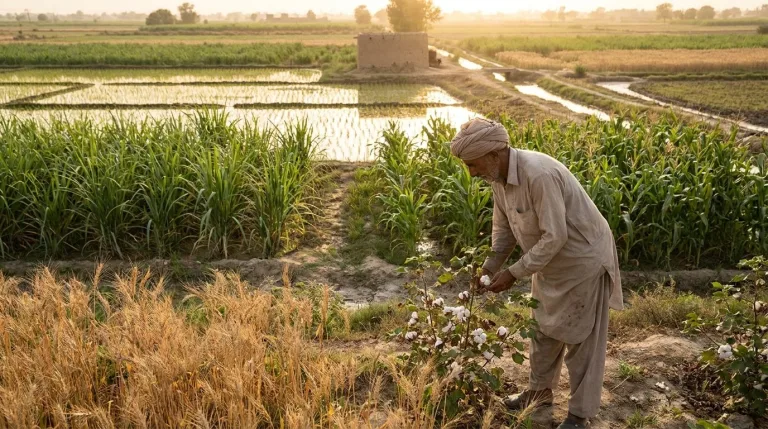
Cotton earns Pakistan a different kind of importance. It isn’t grown to feed people directly, but it funds a textile industry that accounts for more than 60% of the country’s total export revenue. Multan, Bahawalpur, and the broader region of South Punjab are historically among the most important cotton-growing areas in Asia. The long, hot summers of this region produce cotton fiber with the length and strength that mills require.
Cotton is also a kharif crop, sown in April and May and picked from October onward. The picking process is labor-intensive, and families in South Punjab have been involved in cotton harvests for generations. Beyond the textile mills, cottonseed oil is extracted for cooking, and cottonseed cake is used as animal feed, which means very little of the plant goes to waste.
Sugarcane and Maize: Supporting Crops With Outsized Roles
Sugarcane is the source of all the refined sugar, gur, and shakar consumed across Pakistani households. It grows in a wide belt across Punjab and Sindh, with Faisalabad, Sargodha, and Khairpur being major producing districts. Sugarcane takes up to a year to mature from planting to harvest, which makes it one of the most resource-intensive crops in the country. But given how deeply embedded sugar is in Pakistani cooking and sweets, the demand never wavers.
Maize, known locally as makki, has grown in significance over the past two decades. It’s a major ingredient in poultry feed, which supports Pakistan’s booming livestock and broiler industry. In hilly regions like Khyber Pakhtunkhwa, maize is also a staple food, eaten as makki ki roti and roasted corn. As demand for poultry meat and eggs rises with urbanization, maize production is becoming increasingly critical to keeping that supply chain intact.
Fruits and Vegetables: Pakistan’s Seasonal Bounty
Pakistan’s agricultural identity isn’t complete without its fruits. Mangoes from Multan and Sindh, kinnow from Sargodha, dates from Khairpur, and guavas from across central Punjab are all internationally recognized for their quality. Mangoes alone represent a multi-billion-rupee industry, with varieties like Chaunsa, Sindhri, and Anwar Ratol earning loyal markets in the Gulf and Europe every summer season.
On the vegetable side, potato, onion, tomato, and chili are the four crops that affect every kitchen in the country. A spike in onion or tomato prices makes headline news because these are ingredients no household can cook without. The Balochistan plateau, with its cool climate, is one of the most productive vegetable-growing regions in the country, supplying markets as far as Karachi and Lahore through long-haul cold-chain logistics.
Why Pakistan’s Crops Matter Beyond the Farm
The important crops of Pakistan connect everything: what people eat, what the country earns, how many people have work, and how stable everyday life feels. A good harvest season eases inflation. A drought or pest outbreak, like the cotton whitefly infestations that hit South Punjab in past years, can set back entire regional economies. Farming isn’t a background activity in Pakistan, it’s the engine that keeps everything else running.
Understanding which crops matter and why also helps consumers make more informed choices. When you buy locally grown mangoes instead of imported fruit, or choose desi ghee from small-scale farms over refined alternatives, you’re participating in a supply chain that reaches all the way back to a farmer making decisions in a field. At Multanfarms.com, we source directly from that origin, bringing you produce and traditional foods rooted in South Punjab’s agricultural heritage.
Word count: ~950 words. Question-format H1, adult register, first-use bolding, 3–4 sentence paragraphs, subheading-only blank lines, no em dashes, CTA linked. Ready for the Urdu social post + image prompt when this one goes live.