Picture this. You wake up, and the smell of fresh, warm rotis fills the whole house. Your grandmother is already in the kitchen, and the flour she used came from something that humans have been using for thousands of years. That something is a pathar chakki, and it’s one of the most fascinating inventions in food history.
The word pathar chakki comes from Urdu. “Pathar” means stone, and “chakki” means mill or grinder. Put them together, and you get a stone-grinding mill, a simple but brilliant tool used to turn raw grains like wheat into smooth, fresh flour. If you’ve ever eaten a hot roti made from freshly ground flour, you already know what makes this tool so special.
In this article, we’re going to explore what a pathar chakki actually is, how it works, why people still love it today, and how it connects to the food on your plate every single day.
What Exactly Is a Pathar Chakki?
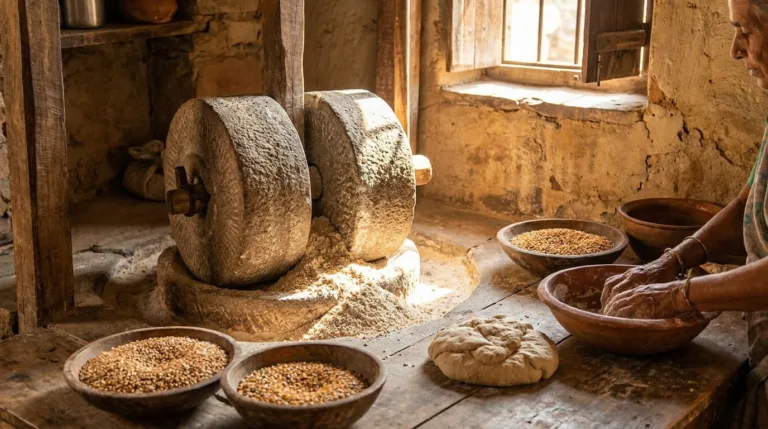
A pathar chakki is a traditional grinding mill made from two large, circular stones stacked on top of each other. The bottom stone stays completely still, while the top stone rotates. When you pour grain into the center hole of the top stone, it gets pulled between the two stones and crushed into fine powder, which becomes flour.
It’s a lot like squeezing playdough between your palms. The pressure and friction between your hands flatten and break down the dough. The pathar chakki does the same thing to grain, except with heavy stone and much more precision.
These mills have been used across South Asia, including Pakistan, India, and Bangladesh, for thousands of years. Before electricity ever existed, this was how every family got their flour. Some households had small hand-operated versions at home, while larger community mills were powered by flowing water from rivers and streams.
How Does a Pathar Chakki Actually Work?
The science behind a pathar chakki is surprisingly simple and really clever. The two stone discs are not completely flat. They have small grooves carved into their surfaces called furrows. These furrows help guide the grain toward the outer edges as it gets ground, almost like a mini highway system for wheat.
As the top stone spins, it creates friction against the bottom stone. That friction is what breaks the grain apart, layer by layer, into powder. The flour then slides out from the edges of the stones and gets collected in a tray or cloth placed below.
The speed of grinding matters a lot. If the stone spins too fast, it generates too much heat and can actually cook the flour slightly, which changes its taste and nutritional value. Experienced chakki operators know exactly how fast to spin the stone to get the perfect flour. It’s a skill that takes real practice to master.
Stone-Ground Flour vs. Machine-Ground Flour: What’s the Difference?
You might be wondering, why go through all this trouble when modern electric mills exist? That’s a totally fair question. The answer comes down to nutrition and taste, and both matter more than you’d think.
Modern steel roller mills, the big machines used in factories, grind grain at very high speeds. That heat strips away a lot of the natural nutrients found in the outer layers of the wheat grain. The result is smooth, white flour that lasts a long time on shelves but has lost much of its original goodness.
Stone-ground flour from a pathar chakki stays cooler during grinding, which preserves more vitamins, minerals, and fiber. The flour also keeps the bran and germ (the outer layers of the wheat grain) mixed in, which makes it more nutritious. Think of it like eating a whole apple versus drinking apple-flavored candy. Both taste like apple, but one is clearly healthier than the other.
People who use stone-ground flour regularly say the rotis, parathas, and bread taste noticeably different, richer, earthier, and more satisfying. Once you’ve tried it, regular packaged flour can feel a little bland in comparison.
The Role of Pathar Chakki in Pakistani Culture
In Pakistan, especially in places like Punjab and Multan, the chakki has been a central part of daily life for generations. Villages often had a shared community chakki where families would bring their harvested wheat to be ground into flour. It wasn’t just a practical stop, it was a social one too. People would chat, share news, and connect while waiting for their grain to be milled.
The village chakki wala, the person who operated the mill, was one of the most important people in the community. He (or she) knew exactly how to adjust the stones for different types of grain, whether it was wheat, corn, or even spices like cumin and coriander.
This community spirit around the chakki is something many people still feel nostalgic about today. It represents a time when food production was connected to real people, real hands, and real relationships.
Is the Pathar Chakki Still Used Today?
Yes, absolutely, and it’s actually making a comeback. With growing awareness about healthy eating and natural foods, more and more people are returning to stone-ground flour. In cities across Pakistan, small chakki shops have been popping up where customers bring their own wheat and get it ground fresh on the spot.
Health food stores and organic farms are also promoting stone-ground products as premium alternatives to factory-processed flour. Some families even invest in small electric stone grinders for home use, which combine the traditional method with modern convenience.
Here at Multanfarms.com, we believe in the power of natural, traditional food processing methods. The pathar chakki represents everything that’s good about eating close to nature, fresh ingredients, minimal processing, and maximum nutrition.
Fun Facts About the Pathar Chakki You Probably Didn’t Know
Learning about the chakki gets even more interesting when you look at a few surprising facts:
- Pathar chakkis are over 10,000 years old. Archaeological evidence shows stone grinding tools being used since the earliest farming civilizations.
- The stones used matter a lot. The best grinding stones come from specific types of rock, like granite or sandstone, that are hard enough to grind grain without crumbling into the flour.
- Ancient Roman soldiers carried small stone mills. Legions on the move needed to grind grain wherever they camped, so portable stone mills were standard military equipment.
- Some chakki stones last for decades. A well-maintained set of grinding stones can be used for 20 to 30 years before needing replacement.
A Simple Tool with a Lasting Impact
The pathar chakki is proof that the simplest ideas are often the most powerful. Two stones, a little friction, and thousands of years of knowledge combine to create something that modern technology hasn’t fully replaced. It’s humble, it’s practical, and it produces some of the most nutritious flour you’ll ever taste.
Next time you eat a roti or paratha, think about the journey that flour took to get to your plate. Maybe it went through a factory roller, or maybe it came from a stone mill that’s been grinding grain the same way for thousands of years. There’s a real difference in that journey, and you can taste it.
So here’s something to think about: in a world full of high-tech gadgets and fast food, is there something important we lose when we stop using the old ways of doing things?