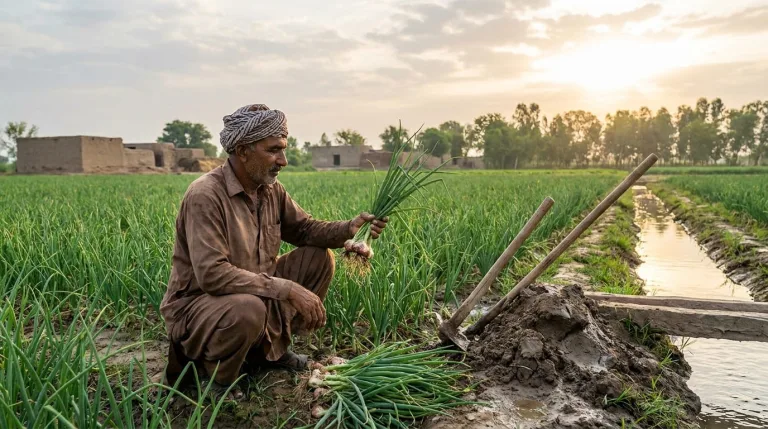
Open up almost any Pakistani kitchen and you will find a pile of onions waiting to go into the pot, from karahi and biryani to a plate of seekh kebab. Have you ever wondered when farmers actually plant the onions that end up on your table? Pakistan actually grows onions across three overlapping windows throughout the year, and knowing which one fits your land can make or break a harvest.
For farmers around Multan and the rest of South Punjab, getting the timing right matters even more. The region’s scorching summers and mild winters create a narrow but workable window for onion bulbs to form properly. In this guide, we will walk through Pakistan’s three onion seasons, explain why winter does most of the heavy lifting, look at which regions grow the most onions, and break down the journey from tiny seed to harvested bulb.
Pakistan’s Three Onion Seasons, Not Just One
Most farmers think of onion farming in terms of two big seasons, but Pakistan actually runs three. The main one is the Rabi crop, the winter season that produces the bulk of the country’s onions. Nurseries go in around October and November, seedlings move to the main field by December or January, and harvest follows from March through May.
The second is the Kharif crop, grown mostly in the hotter, well irrigated parts of Sindh and Balochistan. Sowing happens from May through July, with bulbs ready for harvest between August and October.
There is also a smaller autumn crop that some farmers squeeze in. Nurseries are raised in July, seedlings are transplanted in August, and the bulbs come up by December. This crop exists for one specific reason, it fills the gap right before the Rabi harvest reaches the market, which is exactly when onion prices tend to spike every year.
Why Winter Does Most of the Work
Onions are picky about temperature in a way that is easy to miss if you have never grown them. Early on, the plant just wants to build leaves, and it does that best in cool, mild weather. Think of it like studying before an exam, storing up energy before the real test begins.
That real test is bulb formation, the process where the plant shifts its energy from leaves into the swollen part we actually eat. This shift depends on warming temperatures and longer days, which is exactly what happens as winter turns into spring. Sow too late and the heat arrives before the bulb has had time to grow, sow too early and frost can damage tender seedlings.
This is part of why the Multan region’s climate works so well for the Rabi crop. Cool winter days from December through February give the plant time to build a strong root system and good leaf growth, and by the time the weather warms in March and April, the bulb is ready to take advantage of it before the brutal pre monsoon heat sets in.
Where Onions Actually Grow Best Across Pakistan
Sindh produces more onions than any other province, with districts like Hyderabad, Mirpurkhas, Sanghar, and Tando Allahyar forming the country’s biggest onion belt. The sandy loam soil along the tail ends of irrigation canals suits the crop well, and much of this region’s harvest heads straight to export markets.
Balochistan comes in second for total output, but it actually produces more onion per acre than anywhere else in the country. Districts like Mastung, Kalat, Chaghi, and Khuzdar sit at higher, drier elevations, and that combination of dry air and cooler nights happens to be ideal for growing a dense, flavorful bulb.
Punjab, including the farmland around Multan, Vehari, and D.G. Khan, actually has more total land under onion cultivation than Balochistan. Yields tend to run lower here, and the onions grown in this belt are typically milder and less deeply colored than the red onions from Sindh. Khyber Pakhtunkhwa rounds things out with smaller scale production around Swat and Dir.
From Nursery to Harvest, Step by Step
Growing onions always starts the same way, no matter the season. Seeds get sown thickly into raised nursery beds, where they grow for six to nine weeks into seedlings about the length of a pencil. Only then are they transplanted into rows in the main field, moved one by one by hand.
From there, it is a long wait. Depending on the variety and season, a crop takes anywhere from 100 to 150 days to fully mature after transplanting. Farmers watch for one clear sign that harvest time has arrived, the leafy tops start to flop over and the necks soften, a stage growers call neck fall.
Once roughly half the plants show this neck fall, it is time to pull the bulbs by hand. They are left out in the field for a couple of days to dry off any excess moisture before being sorted, graded, and either sold fresh or set aside for storage.
The Challenges That Keep Farmers Alert
Even with perfect timing, onion farming comes with real risks. Thrips, tiny sap sucking insects, can curl up the leaves and cut yield by as much as half if they go unchecked, especially during dry spells. Farmers keep an eye out with sticky traps and treat early before an infestation spreads.
Water is just as tricky to manage. Too little early on stunts bulb growth, while too much right before harvest can cause the bulbs to rot in the ground. Major flooding in recent years has wiped out large shares of the crop in Sindh and Balochistan, a reminder of how exposed this staple crop is to extreme weather.
Then there is the price rollercoaster. Every year, there is a stretch, usually December into January, when the Rabi crop has not come in yet and stored onions are running low. Prices during this gap can climb several times higher than at harvest time, which is exactly the gap the smaller autumn crop tries to fill.
Why Getting This Right Actually Matters
Onions are not a side dish in Pakistan, they are closer to a foundation. Nearly every salan, curry, and rice dish starts with onions hitting hot oil, which means a shortage does not just raise prices, it ripples through household budgets across the country. Pakistan also exports onions to places like the UAE, Sri Lanka, Malaysia, and Afghanistan, and good timing helps growers catch the strongest export prices.
For farmers in the Multan belt, this all comes back to one simple idea, plant onions when the local climate actually supports the crop’s natural rhythm rather than fighting against it. Get the Rabi window right, manage the thrips and water carefully, and watch for that neck fall before pulling the bulbs.
So the next time you are chopping an onion for dinner, it is worth a second thought, that single bulb traveled through months of careful timing before it reached your kitchen. What would change if more farmers planned their planting calendar around these three seasons instead of guessing? Want to dig deeper into seasonal farming around the Multan region? Visit Multanfarms.com for more guides built specifically for growers in South Punjab.