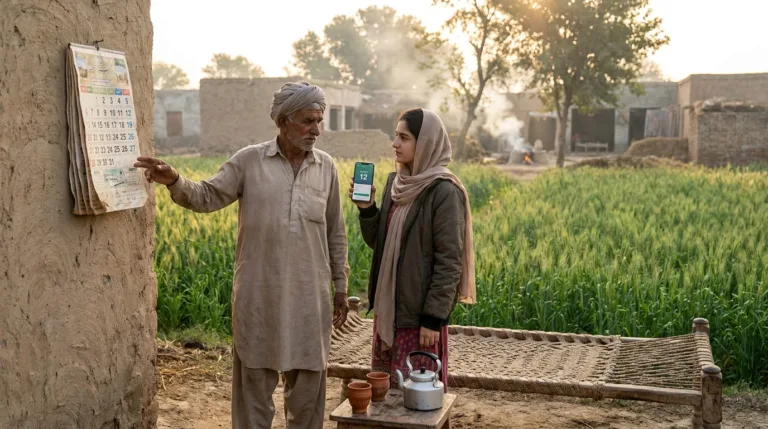
Have you ever heard your grandparents mention a festival coming up, but when you checked your phone’s calendar, you couldn’t find it anywhere? Or maybe you’ve wondered why Eid doesn’t fall on the same date every year? The answer lies in something called the Desi calendar, and it’s actually pretty cool once you understand how it works.
The Desi calendar, also known as the Islamic or Hijri calendar, is completely different from the regular calendar hanging in your classroom. While you’re used to thinking about January, February, and March, millions of people around the world, especially in South Asian countries like Pakistan, also follow a lunar calendar that has its own special months and dates. Today, we’re going to explore what makes this calendar unique and why knowing the Desi month and date can actually be pretty useful, even if you mostly use your smartphone’s calendar.
Understanding this ancient timekeeping system is like having a secret decoder ring for cultural celebrations, religious events, and even some of your family’s traditions. So let’s dive in and unlock the mystery of the Desi calendar!
What Exactly Is the Desi Calendar?
Think of the Desi calendar as your regular calendar’s cousin who does things a bit differently. While the calendar you use in school (called the Gregorian calendar) is based on the sun’s journey around Earth, the Desi or Islamic calendar follows the moon. It’s officially called the Hijri calendar because it started in the year 622 CE, when Prophet Muhammad migrated from Mecca to Medina, an event called the Hijra.
Here’s where it gets interesting. The Desi calendar has 12 months, just like your regular calendar, but each month is either 29 or 30 days long, depending on when you can spot the new moon in the sky. This means a full year in the Desi calendar is only about 354 or 355 days, which is 10 to 11 days shorter than the 365-day year you’re used to. Imagine finishing your school year almost two weeks earlier every single year!
The months have beautiful names like Muharram, Safar, Rabi-ul-Awwal, and Ramadan. You’ve probably heard of Ramadan, the special month when Muslims fast from sunrise to sunset. Each of these months carries its own significance and history.
Why Does the Date Keep Changing?
You know how your birthday always falls on the same date each year? Well, if you celebrated your birthday according to the Desi calendar, it would move about 10 or 11 days earlier on the regular calendar every year. Confusing, right?
Let’s say Eid al-Fitr (the celebration at the end of Ramadan) fell on May 15th this year. Next year, it’ll probably be around May 4th or 5th. The year after that? It’ll shift even earlier. This happens because the Desi calendar year is shorter than the solar year. It’s like having two clocks that run at slightly different speeds, they’ll never stay synchronized.
This is actually why some holidays that follow the Desi calendar seem to “move around” on your phone’s calendar. They’re not actually moving, they’re staying perfectly still on the lunar calendar, but the two calendar systems are slowly drifting apart, like two runners on a track going at different paces.
How Do People Know What Desi Date It Is Today?
In the old days, people would literally go outside and look at the sky to spot the new moon. When they saw that thin crescent moon appear, they’d know a new month had begun. Even today, in many communities, moon sighting committees gather on the 29th day of each month to look for the new moon. It’s like a monthly tradition that’s been happening for over 1,400 years!
However, most people today use a combination of astronomy and tradition. Scientists can calculate exactly when the moon will be in the right position, but many communities still prefer the traditional method of actually seeing the moon with their own eyes. This sometimes leads to different communities starting their months on different days, which is why you might hear someone say “Eid is tomorrow” while someone else says “Eid is the day after tomorrow.” Both are right, they’re just following different moon sighting authorities!
In places like Multan and other cities in Punjab, Pakistan, local Islamic scholars and moon sighting committees announce the beginning of each new month. You can also find the Desi date on Islamic calendars, special apps, or websites that keep track of both calendar systems for you.
The Twelve Special Months You Should Know
The Desi calendar has 12 unique months, and some of them are super important for religious and cultural reasons. Here’s a quick tour:
Muharram is the first month and one of the four sacred months in Islam. It’s a time of reflection, and the 10th day (called Ashura) is especially significant.
Ramadan is probably the most famous month. It’s the ninth month and the time when Muslims fast from dawn to dusk. Imagine not eating or drinking anything while the sun is up for a whole month! It’s a spiritual practice that teaches self-discipline and empathy for those who don’t have enough food.
Shawwal comes right after Ramadan, and the first day of this month is Eid al-Fitr, the big celebration with special prayers, delicious food, new clothes, and gifts (kind of like Christmas morning, but with a different meaning).
Dhul-Hijjah is the 12th and final month, and it includes Eid al-Adha, another major celebration. This month is also when millions of Muslims travel to Mecca for Hajj, the pilgrimage that’s one of the five pillars of Islam.
Each month has its own character and significance, kind of like how December feels different from July in your regular calendar, but for different reasons.
Why This Matters in Places Like Multan
If you live in or around Multan, understanding the Desi calendar isn’t just about religious observance, it’s woven into the fabric of daily life. Markets in Multan buzz with extra activity before major Islamic months. During Ramadan, the timing of everything shifts because people eat suhoor (the pre-dawn meal) and iftar (the meal to break the fast at sunset). Even school and work schedules might adjust!
Local farms and agricultural communities in the Multan region have also historically paid attention to lunar phases for planting and harvesting, though modern farming uses more scientific methods now. Still, many traditional practices connect to the lunar calendar in fascinating ways.
Knowing what Desi month it is helps you understand why your neighborhood might suddenly be decorated with lights and flags, why certain foods appear in the markets, or why your friends might be fasting or celebrating. It’s like having the inside scoop on your community’s rhythm.
Cool Facts About the Lunar Calendar System
Did you know that the moon has been humanity’s timekeeper for thousands of years? Before electric lights brightened our nights, people relied heavily on moon phases to track time. The Desi calendar is one of the few purely lunar calendars still widely used today.
Here’s something mind-blowing: because the Desi calendar year is shorter, Ramadan actually cycles through all the seasons over about 33 years. This means someone might experience Ramadan in the summer heat, and then years later, they’ll fast during the cool winter months. Your great-grandparents might have fasted in completely different weather conditions than your grandparents did!
Another interesting fact? The weekend in the Desi calendar tradition starts on Friday, which is why Friday prayers (Jummah) are so important in Muslim communities. It’s like their Sunday, but with deep religious significance.
Bringing It All Together
So, what’s the Desi month and date today? Well, that depends on when you’re reading this! The beauty of the Desi calendar is that it’s always moving, always changing, always keeping rhythm with the moon above our heads. Whether it’s the sacred month of Muharram, the joyful month of Shawwal, or the blessed month of Ramadan, each has its own special meaning.
Understanding the Desi calendar system helps you appreciate the diversity in how people experience time. While your school planner might be marked with soccer practice and science project due dates, someone else’s calendar is marked with moon sightings, prayer times, and centuries-old traditions. Both are valid ways of organizing our lives, and knowing about both makes you more connected to the rich cultural tapestry of places like Multan and beyond.
Next time you hear someone mention an Islamic month or wonder why a holiday is “moving” on the calendar, you’ll know the secret. You’ll understand that they’re following the moon, just like humans have done for millennia. Pretty cool, right? What other calendar systems do you think exist around the world, and how might they be different from the ones we’ve talked about today?