Pakistan is home to some of the most celebrated mangoes in the world. Every summer, markets fill up with golden, fragrant fruit that people across the country, and even across the globe, can’t get enough of. But have you ever stopped to wonder where all these mangoes actually come from? The answer is a fascinating geography lesson wrapped inside your favourite fruit.
Pakistan doesn’t just grow mangoes in one place. The country has several dedicated mango-growing regions, each shaped by its own climate, soil type, and heritage varieties. By the time you finish reading this, you’ll know exactly which parts of Pakistan put that sweetness on your plate.
Why Pakistan Is a Global Mango Powerhouse
Pakistan consistently ranks among the top five mango-producing countries in the world. The country produces somewhere between 1.7 and 2 million tonnes of mangoes every year, supplying markets across Europe, the Middle East, and Central Asia. That’s not just impressive, it’s a point of genuine national pride.
The secret behind this success is a combination of fertile soil, a long growing season, and generations of farmers who have perfected the craft of mango cultivation. The subtropical climate of Pakistan’s major growing regions delivers exactly the right balance of heat, sunlight, and winter chill that mango trees need to produce fruit in abundance.
Punjab: The Heart of Pakistan’s Mango Belt
When people talk about Pakistani mangoes, they’re mostly talking about Punjab. This province accounts for the overwhelming majority of the country’s total mango production, and it’s easy to see why. The flat, fertile plains fed by rivers like the Chenab and the Ravi create ideal conditions for large-scale mango orchards.
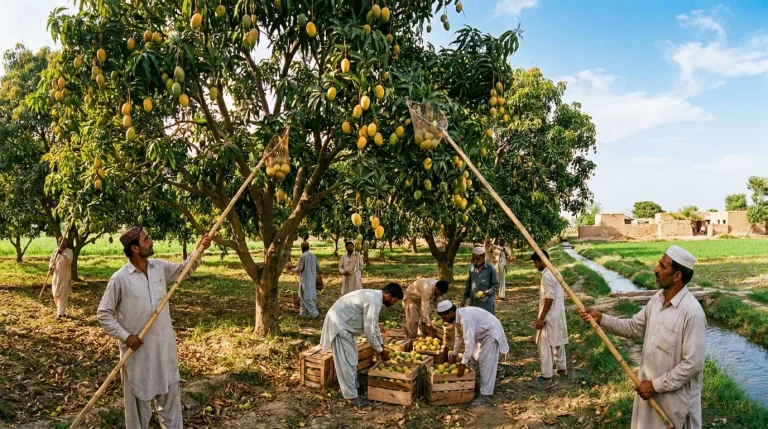
Multan sits right at the centre of this mango belt and has been famous for its mangoes for centuries. The city and its surrounding districts, including Muzaffargarh, Vehari, and Lodhran, are blanketed with mango orchards that stretch as far as the eye can see. The soil here is deep and loamy, and the summer heat is intense enough to ripen fruit to peak sweetness. Varieties like Chaunsa, Anwar Ratol, and Sindhri that come out of this region are considered some of the finest in the world.
Moving further south, Rahim Yar Khan in southern Punjab is another powerhouse district. Its slightly drier climate produces mangoes with a particularly concentrated sweetness, and the area is a major source of export-quality fruit. Bahawalpur and its surroundings also contribute significantly to the provincial harvest, with orchards that have been cultivated for generations.
Sindh: Home of the Legendary Sindhri
While Punjab leads in volume, Sindh has its own mango identity, and it’s built around one legendary variety, the Sindhri. Often called the “king of Sindhi mangoes,” the Sindhri is large, golden, and almost fibre-free, which makes it incredibly smooth to eat.
The districts of Mirpurkhas, Hyderabad, and Tando Allahyar are the main mango-growing hubs of Sindh. The soil in these areas, enriched by centuries of Indus River flooding, is exceptionally fertile. Mango orchards here tend to produce fruit slightly earlier in the season than Punjab, which means Sindhi mangoes often hit the market first. That early-bird advantage benefits farmers, distributors, and export channels alike.
Khyber Pakhtunkhwa and Emerging Regions
Khyber Pakhtunkhwa might not be the first province that comes to mind when you think of mangoes, but it does have mango cultivation in its lower districts, particularly around Peshawar, Mardan, and Nowshera. The volume here is much smaller compared to Punjab and Sindh, but local varieties have loyal fans who swear by their distinct flavour profile.
In Balochistan, the southern lowland areas near Turbat and Kech have shown real potential for mango growing, though commercial-scale production is still developing. As water management infrastructure improves across these areas, more farmers are experimenting with mango cultivation to diversify their income and tap into growing export demand.
What Makes Each Region’s Mangoes Taste Different?
You might be wondering, if it’s all the same fruit, why does a Chaunsa from Multan taste so different from a Sindhri from Mirpurkhas? The answer lies in something farmers and food experts call terroir, a concept that simply means the flavour fingerprint left on a crop by its specific environment. Soil composition, water source, humidity, and even the microclimate of a particular orchard all leave their mark on the fruit.
Multan’s intense heat and dry summer air, for example, concentrate the sugars in the Chaunsa, giving it that rich, honey-like sweetness the variety is famous for. Sindh’s slightly more humid conditions and Indus-fed soil give the Sindhri a mild, floral quality that’s entirely different in character. Think of it like how the same recipe cooked in two different kitchens can produce subtly but noticeably different results.
Pakistan’s Mango Season and Why Timing Matters
The mango season in Pakistan typically runs from May through September. Sindh usually kicks things off in May with early-ripening varieties, followed by Punjab peaking through June, July, and August, when the most prized varieties like Chaunsa reach full maturity. Late varieties carry the season all the way into September.
This staggered ripening across regions is actually a major economic advantage. It means Pakistan can supply fresh mangoes to both domestic and export markets over a longer continuous window, rather than flooding the market all at once. Farmers, packaging facilities, and freight operators all benefit from this natural rhythm, and so do the millions of people who want to eat fresh mangoes for as many weeks as possible.
Multanfarms.com: Rooted in the Heart of the Mango Belt
At Multanfarms.com, we’re grounded right in the centre of Pakistan’s most celebrated growing region. Multan’s orchards aren’t just a backdrop for us, they’re the source of our passion for authentic, high-quality agricultural products. Whether you want to learn more about the fruits, foods, and natural products that this remarkable region produces, or you’re looking to explore premium offerings sourced straight from Multan’s fertile lands, we have you covered.
Visit us at Multanfarms.com and discover what makes Multan’s harvest so special.