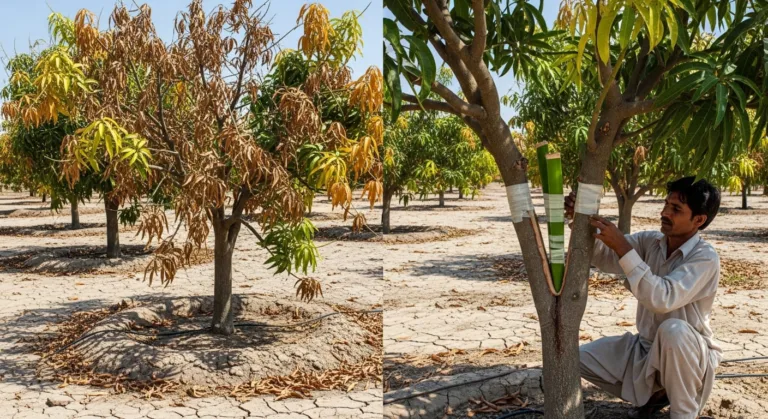
Picture this: you’re walking through a sunny mango orchard in Multan, excited to see those golden, juicy mangoes hanging from the trees. But instead of healthy green leaves and plump fruit, you notice something weird. Some trees look sick, with wilting leaves and dying branches. What’s going on? Well, you’ve just witnessed one of the biggest problems facing Multan’s famous mango farms, a disease called mango wilt. But don’t worry, there’s hope! Farmers are fighting back using a clever technique called grafting.
Multan is known as the “City of Saints,” but it should also be called the “City of Mangoes!” This region produces some of Pakistan’s most delicious mango varieties like Sindhri, Chaunsa, and Anwar Ratol. But lately, mango wilt has been causing serious trouble for farmers. In this article, we’ll explore what mango wilt is, why it’s such a big deal in Multan, and how grafting might just be the superhero solution these orchards need.
What Exactly Is Mango Wilt?
Imagine you’re drinking your favorite juice through a straw, and suddenly someone pinches the straw shut. No matter how hard you try, nothing comes through, right? That’s basically what happens to a mango tree when it gets wilt disease. The tree’s “drinking straws” (actually called xylem vessels) get blocked, and water can’t travel from the roots to the leaves and branches.
Mango wilt is caused by a sneaky fungus that lives in the soil. This fungus enters the tree through its roots and travels upward, blocking the pathways that carry water and nutrients. The result? The tree starts to “wilt” or droop, leaves turn yellow or brown, branches die off, and eventually, the whole tree might die. It’s like watching a plant die of thirst even when there’s plenty of water in the ground.
In Multan’s hot climate, where temperatures can soar above 40°C (104°F) in summer, mango trees are already stressed. Add the wilt disease to the mix, and you’ve got a recipe for disaster. Farmers have been losing entire orchards to this disease, which means less fruit, less income, and a threat to Multan’s reputation as a mango paradise.
Why Is Multan’s Climate a Perfect Storm for Mango Problems?
You might wonder, why is mango wilt such a big issue specifically in Multan? Well, it’s all about the environment. Multan has extremely hot summers, and the soil conditions can make trees more vulnerable to disease. When trees are stressed from heat and don’t get enough water, their natural defenses weaken, kind of like how you’re more likely to catch a cold when you’re tired and run down.
The irrigation practices in the region can also play a role. If water sits around the roots too long or if the soil doesn’t drain well, it creates the perfect home for that nasty wilt-causing fungus to multiply. Plus, many of Multan’s mango orchards have been growing trees in the same spots for decades, and over time, the fungus builds up in the soil like an unwelcome guest that just won’t leave.
Enter the Hero: Grafting!
So how do farmers fight back against mango wilt? This is where grafting comes in, and trust me, it’s one of the coolest agricultural techniques you’ll ever learn about. Grafting is like giving a plant a superpower upgrade by combining two different plants into one super-plant.
Here’s how it works: farmers take a cutting (called a scion) from a mango tree that produces delicious fruit and attach it to the roots and lower stem (called a rootstock) of a different plant that’s naturally resistant to diseases. It’s like creating a mango tree that has the taste of one variety and the disease-fighting strength of another. Pretty clever, right?
Think of it like this: imagine if you could combine the speed of a cheetah with the strength of an elephant. That’s essentially what grafting does for mango trees. The top part gives you the tasty mangoes you want, while the bottom part protects the whole tree from soil-borne diseases like wilt.
How Does Grafting Actually Work?
The grafting process might sound complicated, but the basic idea is simple. First, farmers identify rootstock plants that are known to resist mango wilt. These might be wild mango varieties or specially bred varieties that don’t taste great but are tough as nails when it comes to fighting off fungi.
Next, they make a careful cut on both the rootstock and the scion (the part from the yummy mango tree). These cuts need to match up perfectly, almost like puzzle pieces. Then they bind them together tightly with special tape or grafting wax, keeping everything clean to prevent infections. Over the next few weeks, something amazing happens: the two plants actually grow together and become one! The cells from both plants merge at the cut surface, and soon you can’t even tell where one plant ends and the other begins.
For farmers in Multan, this means they can keep growing their prized mango varieties, the ones that make Multan mangoes famous worldwide, while protecting their investment from wilt disease. It’s like getting the best of both worlds.
Real Results from Multan’s Mango Farms
Farms across Multan, including innovative operations like Multanfarms.com, have started using grafted mango trees with impressive results. Farmers who’ve switched to grafted trees report that their orchards stay healthier longer, produce more consistent yields, and show much better resistance to wilt disease.
One farmer might tell you that before using grafted trees, he was losing 20-30% of his trees every few years to wilt. After switching to grafted varieties, that number dropped dramatically. The trees still face hot weather and other challenges, but they’re no longer defenseless against the soil fungus that causes wilt.
Another benefit? Grafted trees often start producing fruit faster than trees grown from seed. While a seed-grown mango tree might take 5-7 years to produce its first fruit, a grafted tree can start producing in just 3-4 years. For farmers, that means getting back their investment sooner and spending less time worrying about whether their young trees will survive long enough to bear fruit.
What Can You Learn from This?
The story of mango wilt and grafting in Multan teaches us some important lessons. First, it shows how science and traditional farming can work together to solve real-world problems. Grafting isn’t a new technique, people have been doing it for thousands of years, but modern farmers are using it in smart new ways to tackle modern challenges.
Second, it reminds us that nature is constantly changing, and we need to adapt. Diseases evolve, climates change, and what worked yesterday might not work tomorrow. The farmers in Multan who are embracing grafting are the ones who’ll still be growing delicious mangoes for years to come.
Finally, this story connects to something bigger. Every time you bite into a sweet, juicy mango, there’s a whole world of science, hard work, and problem-solving behind that fruit. Farmers in places like Multan are constantly working to bring you the best produce possible while fighting off diseases, dealing with extreme weather, and protecting their livelihoods.
The Future of Mango Farming in Multan
Looking ahead, grafting represents just one tool in the toolkit for Multan’s mango farmers. Research continues into finding even more resistant rootstock varieties, better irrigation methods to prevent fungus growth, and organic treatments that can help control wilt disease. Some farms are experimenting with soil treatments, better drainage systems, and even planting patterns that reduce disease spread.
As climate change brings more extreme weather to regions like Multan, techniques like grafting will become even more important. The ability to combine disease resistance with fruit quality means farmers can adapt to changing conditions without sacrificing what makes Multan mangoes special.
What’s really exciting is that these innovations aren’t just helping Multan. As farmers share their knowledge and techniques, other mango-growing regions facing similar challenges can benefit too. It’s a perfect example of how solving local problems can have global impact.
So next time you enjoy a delicious mango, maybe from Multan or maybe from somewhere else, take a moment to appreciate the science and hard work that made it possible. And remember, sometimes the best solutions come from combining old wisdom (like grafting) with new challenges (like mango wilt). Who knows? Maybe you’ll be inspired to learn more about agriculture, plant science, or how we can help farmers around the world grow better, healthier crops. After all, the future of our food depends on creative problem-solvers willing to tackle tough challenges, one tree at a time!