Have you ever noticed those light brown or greyish powder packets at beauty stores labeled “Multani Mitti” and wondered what makes them so special? Here’s a fun fact: this natural clay has been used for thousands of years, and it gets its name from the city of Multan in Pakistan! That’s right, this amazing natural product is so closely connected to Multan that the city’s name is literally part of what we call it.
Imagine finding a natural substance right in the ground that can clean your skin, cool you down on hot days, and even help treat minor skin problems, all without any chemicals or artificial ingredients. Sounds pretty amazing, right? That’s exactly what Multani mitti is! This special clay has been treasured for centuries, not just in Pakistan but all across South Asia and beyond. Ancient queens and emperors used it, and today, people around the world still use it for beauty and wellness.
In this article, we’re going to explore the fascinating connection between Multani mitti and the city of Multan. You’ll discover why this particular clay is found in Multan, how it forms naturally in the earth, what makes it different from regular dirt, and why it’s been such an important part of the region’s economy and culture. Whether you’re curious about natural beauty products, interested in geology (the study of rocks and earth), or just want to know more about this famous Pakistani product, you’re in for an interesting journey!
What Exactly Is Multani Mitti and Where Does It Come From?
Let’s start with the basics. Multani mitti is a type of clay, but it’s not just any ordinary clay you’d find in your backyard. Scientists call it “Fuller’s Earth,” which is a fancy name for clay that has special absorbent properties (meaning it can soak up oils and liquids really well). Think of it like a natural sponge, but instead of soaking up water, it’s particularly good at absorbing oils, dirt, and impurities.
This special clay forms over millions of years through natural geological processes. When certain types of volcanic rocks break down and mix with water and other minerals in the ground, they create this unique clay. The process is super slow, kind of like how it takes millions of years for diamonds to form deep in the earth. The specific conditions in and around Multan, including the soil composition, climate, and ancient geological activity, created the perfect environment for this clay to develop.
Now here’s where it gets interesting: while you can find Fuller’s Earth in various parts of the world, the clay from Multan has some unique characteristics that make it particularly valuable. The mineral content, texture, and color of Multani mitti can vary depending on exactly where it’s mined, but the clay from Multan is known for being especially pure and effective. That’s why it earned its special name and reputation!
Why Multan Became the Clay Capital
You might be wondering, “Why Multan specifically? What’s so special about that place?” Great question! Multan’s connection to this clay isn’t just random, it’s based on some really interesting geography and history.
Multan sits in the southern part of Punjab, in a region that was once covered by ancient seas and rivers millions of years ago. When these water bodies dried up, they left behind layers of sediment (that’s material like sand, mud, and minerals that settles at the bottom of water). Over time, these sediment layers compressed and transformed into different types of rock and clay. The specific combination of minerals in this area created deposits of the special absorbent clay we now call Multani mitti.
Historically, Multan was a major trading hub on the famous Silk Road, the ancient network of trade routes connecting Asia, the Middle East, and Europe. Merchants traveling through Multan discovered this amazing local clay and started trading it along with silk, spices, and other valuable goods. Stories and knowledge about the clay’s benefits spread far and wide. People from distant lands specifically sought out clay from Multan because word got around about how effective it was.
The city became so famous for this clay that eventually, people everywhere started calling this type of clay “Multani mitti,” even if it came from somewhere else! It’s like how we call facial tissues “Kleenex” even if they’re made by a different company. The name stuck because Multan was the original and most famous source.
How Multani Mitti Is Extracted and Processed
So how does this clay go from being buried in the ground to becoming the fine powder you can buy at stores or from places like Multanfarms.com? The process is actually quite fascinating!
Mining the clay is the first step. In areas around Multan, workers dig into the earth to reach clay deposits. This isn’t like mining for gold or diamonds with huge machinery and deep tunnels. Clay extraction is usually done in open pits (imagine a large, shallow excavation site). Workers identify areas with good-quality clay by looking at the color and texture of the soil layers. The best quality Multani mitti is usually found at certain depths where the clay has had the right conditions to form properly.
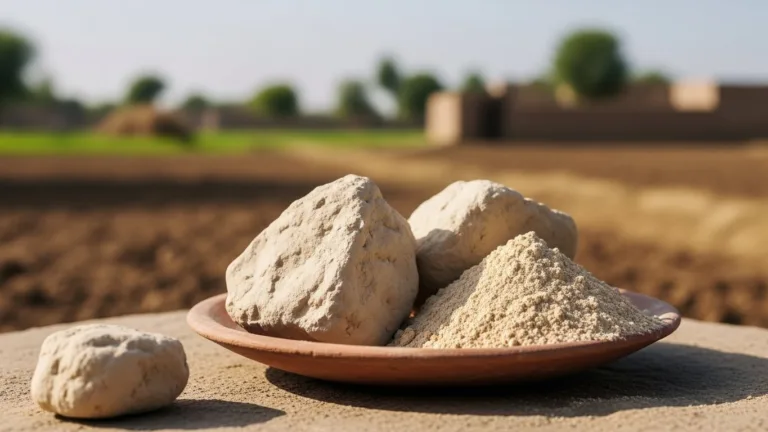
Once extracted, the raw clay looks very different from the fine powder you might be familiar with. It comes out in large, chunky pieces that need to be processed. The processing stage involves several steps. First, the clay chunks are broken into smaller pieces and cleaned to remove any rocks, roots, or other unwanted materials. Then comes the drying process, which is super important. The clay is spread out in the sun (Multan has plenty of that!) and left to dry completely.
After drying, the clay is ground into a fine powder. Traditional methods involved manually pounding and grinding the clay, but modern facilities use machines that can grind it more efficiently and consistently. The final product is then sifted through fine screens to ensure the texture is smooth and uniform. Some producers also test the clay to make sure it meets quality standards before packaging it for sale. The whole process might sound simple, but getting high-quality Multani mitti requires skill and careful attention at each stage!
The Amazing Properties That Make Multani Mitti Special
What makes Multani mitti so useful that people have been using it for thousands of years? Let’s break down its superpowers!
First, it’s an incredible oil absorber. Your skin naturally produces oils (called sebum), and while some oil is good for your skin, too much can make your face look shiny and can clog pores. When you apply a Multani mitti face mask, it acts like a magnet for excess oil, soaking it up and leaving your skin feeling fresh and clean. It’s similar to how paper towels absorb spilled water, except Multani mitti is specifically good at absorbing oils.
Second, it has a natural cooling effect. In hot cities like Multan, where summer temperatures can soar above 45°C, this cooling property has been a lifesaver for centuries! When you apply Multani mitti mixed with water to your skin, it creates a cool sensation as it dries. This happens because of the clay’s mineral composition and the evaporation process. It’s like a natural air conditioner for your skin! Many people in Multan and throughout Pakistan apply Multani mitti face masks during hot summer days specifically for this cooling relief.
Third, it’s a gentle exfoliator (something that removes dead skin cells). As the clay dries on your skin, it slightly contracts or tightens. When you wash it off, it takes dead skin cells and dirt with it, leaving your skin smoother. Unlike harsh chemical scrubs, Multani mitti does this gently, making it suitable even for sensitive skin types.
Finally, it contains natural minerals like magnesium, silica, quartz, iron, calcium, and other elements that can be beneficial for skin health. These minerals help nourish the skin while the clay does its cleansing work. It’s like getting a nutritious meal for your skin!
Traditional and Modern Uses of Multani Mitti in Multan
In Multan and throughout Pakistan, Multani mitti has been part of daily life and beauty routines for generations. Let’s explore how people traditionally used it and how they continue to use it today.
Traditional beauty practices involving Multani mitti are deeply rooted in South Asian culture. Grandmothers would mix the clay powder with rose water, milk, yogurt, or plain water to create face masks for brides before weddings. The goal was to give the bride’s skin a natural glow and smoothness. Even regular folks would use Multani mitti masks once or twice a week as part of their skincare routine. Before modern shampoos existed, people also used Multani mitti to clean their hair, it absorbs oil and dirt from the scalp really effectively!
Some traditional uses went beyond beauty. People would sometimes apply Multani mitti paste to minor burns or skin irritations because of its cooling and soothing properties. Others used it as a natural deodorant, since it absorbs moisture and odor. In extremely hot weather, some people would apply a thin layer of Multani mitti paste to their bodies before bathing, helping them feel cooler throughout the day.
Modern applications have expanded even further. Today’s beauty industry has incorporated Multani mitti into all sorts of products. You’ll find it in face masks, facial scrubs, soaps, body wraps, and even hair care products. Spas around the world offer Multani mitti treatments, sometimes charging quite a bit of money for something that’s incredibly affordable in its natural form!
Interestingly, Multani mitti also has industrial uses. Remember how we mentioned it’s called “Fuller’s Earth”? That name comes from an old profession called “fullers” who used this type of clay to clean wool and remove oils from fabric. Even today, some industries use fuller’s earth (including Multani mitti) in processes that require oil absorption, like cleaning up oil spills or purifying certain liquids.
The Economic and Cultural Importance for Multan
For the city of Multan, Multani mitti isn’t just a beauty product, it’s part of the city’s identity and economy. Let’s think about what this means for the people who live there.
Economically, the Multani mitti industry provides livelihoods for many families in and around Multan. From the workers who extract the clay to those who process it, package it, and sell it, this natural resource creates jobs and income. Small businesses and farms, like Multanfarms.com, benefit from being able to offer authentic Multani mitti directly from its place of origin. When people specifically seek out Multani mitti from Multan (rather than generic fuller’s earth from elsewhere), it helps support the local economy.
Culturally, Multani mitti is a source of pride for Multanis. It’s one of the things their city is famous for, alongside Multan’s beautiful shrines, delicious mangoes, and rich history. When someone from Multan travels to another city or country, they often bring Multani mitti as a gift, kind of like how people from Karachi might bring dried fruits or people from Peshawar might bring chappal (traditional sandals). It’s a way of sharing something unique and special about their hometown.
There’s also an educational aspect. Local schools in Multan sometimes teach students about Multani mitti as part of lessons about their region’s natural resources and economic products. It connects kids to their local geography and history in a tangible way. When you can hold a handful of local clay that’s been famous for thousands of years, history suddenly feels a lot more real and interesting!
How to Use Multani Mitti Safely and Effectively
If all this talk about Multani mitti has made you want to try it yourself, that’s great! But let’s make sure you know how to use it properly and safely.
The basic Multani mitti face mask is super simple to make. Take about two tablespoons of Multani mitti powder and add enough water (or rose water for a fancier version) to make a smooth paste. The consistency should be like thick pancake batter, not too runny and not too thick. Apply this paste evenly on your face, avoiding the area right around your eyes. Let it sit for about 10-15 minutes, just until it’s dry but not completely hardened. Then wash it off with cool water, splashing gently until all the clay is removed.
Here are some important safety tips. First, if you have very dry or sensitive skin, don’t leave the mask on too long, and consider mixing the Multani mitti with milk or yogurt instead of just water to make it less drying. Second, always do a patch test first (apply a tiny bit on your wrist and wait 24 hours to see if you have any reaction) before putting it all over your face. Third, don’t use Multani mitti more than once or twice a week, using it too often can dry out your skin too much.
For hair care, you can mix Multani mitti powder with water to create a paste that’s thinner than what you’d use for your face. Apply it to your scalp and hair, leave it for 15-20 minutes, then rinse thoroughly with water. Some people like to follow up with a conditioner since the clay can make hair feel a bit dry initially.
When buying Multani mitti, try to get it from reliable sources like Multanfarms.com that offer authentic, pure clay from Multan. The quality can vary quite a bit between different brands and sources!
The Future of Multani Mitti in a Changing World
As we look ahead, what does the future hold for this ancient natural product? It’s actually pretty exciting!
The global trend toward natural and organic products is working in Multani mitti’s favor. More and more people around the world are becoming skeptical of beauty products loaded with chemicals they can’t pronounce. They’re looking for natural alternatives, and Multani mitti fits perfectly into this movement. It’s been used safely for thousands of years, it’s completely natural, and it’s effective. International beauty brands are starting to incorporate it into their products, which means increasing demand.
However, this growing popularity also brings challenges. As demand increases, there’s a risk of over-mining in certain areas around Multan. Environmental awareness is becoming important, we need to make sure that extracting Multani mitti doesn’t damage the land or deplete this natural resource faster than it can form (which, remember, takes millions of years!). Sustainable practices in mining and processing will be crucial.
There’s also the issue of authenticity. As Multani mitti becomes more popular globally, some companies might sell regular fuller’s earth or even inferior quality clay under the “Multani mitti” label. Protecting the authenticity and reputation of genuine Multani mitti from Multan will be important. It’s similar to how champagne can only truly come from the Champagne region of France, maybe there need to be certifications or protections for authentic Multani mitti from Multan!
Wrapping Up the Story of Multan’s Famous Clay
So there you have it, the complete story of Multani mitti and its special connection to the city of Multan! This remarkable clay has traveled through millions of years of geological processes, thousands of years of human use, and continues to be relevant in today’s modern world. It’s a perfect example of how sometimes the best solutions are the ones nature provides, and how local natural resources can become internationally recognized products.
The next time you see a packet of Multani mitti at a store or beauty shop, you’ll know exactly why it has that name. You’ll understand that it comes from specific clay deposits in and around Multan, formed over millions of years through natural processes. You’ll appreciate that it’s not just a beauty product but a piece of cultural heritage, economic importance, and geological wonder all rolled into one humble powder.
Have you ever used Multani mitti or seen it used in your home? Now that you know its amazing story and connection to Multan, will you look at it differently? Maybe you’ll even be inspired to try making your own face mask and experiencing firsthand what people have treasured for thousands of years!