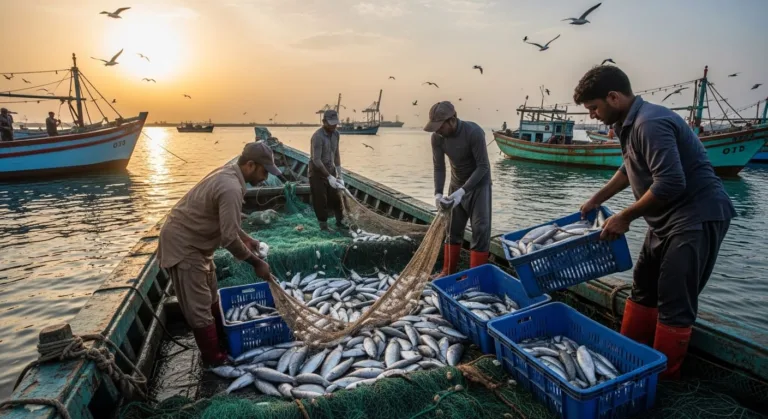
Have you ever stopped to think about where the fish on your dinner plate comes from? If you live in Pakistan, there’s a good chance it came from one of the country’s busy fishing ports! Pakistan has an amazing fishing industry that feeds millions of people and helps the country’s economy grow stronger every day. From the Arabian Sea’s sparkling waters to the small fishing villages dotting the coast, this industry is way more interesting than you might think.
Pakistan’s fishing industry isn’t just about catching fish, it’s about providing jobs for thousands of families, feeding the nation, and even sending seafood to other countries. Imagine a whole world of fishermen, boat builders, fish sellers, and factory workers all working together to bring fresh seafood to your local market. That’s the power of this industry! In this article, we’ll dive deep into how Pakistan’s fishing industry works, why it matters, and what makes it so special.
Where Does All This Fishing Happen?
Pakistan is blessed with a long coastline that stretches over 1,000 kilometers along the Arabian Sea. That’s about the distance from Karachi to Lahore! This coastline is like a giant natural treasure chest full of fish and other sea creatures. The two main coastal areas are in Sindh and Balochistan provinces, with major fishing ports in cities like Karachi, Gwadar, and Pasni.
Think of these fishing ports as busy bus stations, but instead of buses, you have fishing boats coming and going all day and night. Karachi’s fish harbor is especially impressive. It’s one of the biggest in the region, with hundreds of boats leaving every day to catch fish in the deep waters of the Arabian Sea. The fishermen might stay out at sea for days or even weeks, depending on what they’re catching and how far they need to travel.
But it’s not just the sea! Pakistan also has inland fishing in rivers, lakes, and fish farms. The Indus River and its connected waterways are home to freshwater fish that many people love to eat. It’s like having two different fishing worlds, one salty and one fresh, both working together to feed the nation.
What Kind of Fish Are We Talking About?
Pakistan’s waters are home to hundreds of different types of fish and seafood. Some of the most popular catches include pomfret, a flat, tasty fish that many families love, and shrimp, which Pakistan actually exports to countries all over the world. There’s also tuna, ribbon fish, and squid, each one important in its own way.
Here’s something cool: Pakistan is one of the world’s top exporters of shrimp! These small, pink creatures are so valuable that people sometimes call them “pink gold.” Fishermen use special nets and techniques to catch shrimp without harming the ocean’s ecosystem. It’s like a delicate balancing act between catching enough to sell and making sure there will be plenty left for future generations.
You might be surprised to learn that not all the fish caught goes to Pakistan’s markets. A large portion gets frozen and shipped to other countries, especially in the Middle East, Europe, and Asia. This means that Pakistani fishermen are helping feed people thousands of miles away, which is pretty amazing when you think about it!
How Do Fishermen Actually Catch All This Fish?
Fishing in Pakistan happens in different ways, depending on what’s being caught and where. Traditional fishermen often use small boats and simple nets, just like their fathers and grandfathers did before them. They know the sea like you know your neighborhood, understanding where fish like to gather and what times are best for catching different species.
Modern fishing is a bit different. Large commercial boats use advanced technology like sonar (a kind of underwater radar) to find schools of fish. These bigger vessels can stay at sea for longer periods and catch much more fish than smaller boats. It’s the difference between fishing with a simple rod versus using a high-tech fishing machine!
There’s also something called aquaculture, which is basically fish farming. Instead of catching wild fish, farmers raise them in special ponds or coastal areas. This method is growing more popular in Pakistan because it helps meet the increasing demand for fish without putting too much pressure on ocean populations. Think of it like the difference between hunting wild animals and raising livestock on a farm.
Why Does This Industry Matter So Much?
The fishing industry is super important to Pakistan’s economy and its people. First, it provides jobs for over 400,000 people directly, that’s like filling several large cricket stadiums! And that’s not counting all the people who work in related businesses like fish processing, ice making, net repair, and transportation.
Second, fish is an essential source of protein for millions of Pakistani families. Protein helps your body grow strong and stay healthy, and fish is one of the most affordable ways to get it. For many coastal communities, fishing isn’t just a job, it’s a way of life that’s been passed down through generations. These fishing families have incredible knowledge about the sea, weather patterns, and marine life.
The industry also brings in valuable foreign money through exports. When Pakistan sells shrimp and fish to other countries, it earns money that helps the national economy. In recent years, Pakistan has earned hundreds of millions of dollars from seafood exports. That money can be used to build schools, hospitals, and roads that benefit everyone.
What Challenges Does the Industry Face?
Like any industry, fishing in Pakistan has its share of problems. One big challenge is overfishing, which means catching so many fish that there aren’t enough left to reproduce and maintain healthy populations. It’s like eating all the seeds from your garden and then wondering why nothing grows next year! The government and fishing communities are working together to create rules about how much can be caught and when certain areas should be left alone to recover.
Pollution is another serious issue. When plastic waste, chemicals, and sewage end up in the ocean, they can harm fish and make them unsafe to eat. Imagine trying to live in a house that’s slowly filling up with garbage, that’s what pollution does to ocean creatures. Coastal communities and environmental groups are working hard to clean up beaches and educate people about protecting marine environments.
Climate change is also affecting Pakistan’s fishing industry. As ocean temperatures rise and weather patterns change, fish populations move to different areas or decline in number. Fishermen who’ve worked the same waters for decades are noticing these changes. It’s a reminder that we all need to take care of our planet if we want industries like fishing to survive for future generations.
The Future Looks Promising!
Despite the challenges, Pakistan’s fishing industry has a bright future ahead. The government is investing in better ports, modern equipment, and training programs to help fishermen improve their skills. New fish farms are being developed, especially for high-value species like prawns and tilapia. This means more jobs and more food for everyone!
There’s also growing awareness about sustainable fishing practices. This means catching fish in ways that don’t harm the ocean’s ecosystem and ensure there will be fish for many years to come. Young people in coastal areas are learning both traditional fishing wisdom and modern techniques, creating a perfect blend of old and new knowledge.
Technology is playing a bigger role too. Fishermen are using smartphones and GPS to navigate better and find fish more efficiently. Processing plants are upgrading their equipment to meet international quality standards, which opens up even more export opportunities. It’s exciting to think about where this industry might be in ten or twenty years!
So, What Have We Learned?
Pakistan’s fishing industry is much more than just people catching fish. It’s a vital part of the country’s economy that feeds millions, provides livelihoods for hundreds of thousands of families, and connects Pakistan to the global marketplace. From the traditional fisherman casting his net at dawn to the modern processing plant preparing shrimp for export, every part of this industry plays an important role.
The next time you see fish at your local market or enjoy a delicious fish dish at home, remember the incredible journey it took to get there. Think about the fishermen braving the waves, the workers processing and packing the catch, and the drivers transporting it to markets across the country. The fishing industry might seem simple on the surface, but it’s actually a complex and fascinating world that touches so many lives.
What can you do to help protect this important industry? Maybe start by learning more about sustainable seafood choices, or by making sure you don’t litter near water sources. After all, the ocean’s health affects us all, whether we live by the coast or hundreds of miles inland!