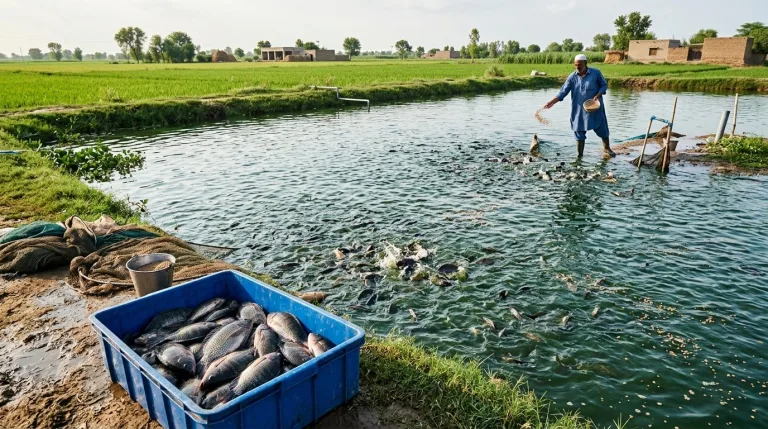
Have you ever wondered how a small fish can become an important part of a farmer’s business? Tilapia in Pakistan is becoming an interesting choice for fish farmers because this fish grows well in warm water and can be raised in ponds and other farming systems.
Tilapia is also popular around the world. One of the most commonly farmed types is Nile tilapia, scientifically known as Oreochromis niloticus. It can eat a variety of natural and prepared foods, grows relatively quickly, and can adapt to different farming conditions.
What Is Tilapia?
Tilapia is a freshwater fish that belongs to the cichlid family. Think of it as a fish that is quite good at adapting to its surroundings, a bit like a plant that can grow in different types of soil.
Several tilapia species are farmed around the world, but Nile tilapia is one of the most widely cultured species. It is especially suited to warm climates, which makes temperature an important factor when farmers consider tilapia farming.
Tilapia is an omnivorous fish, which means it can eat both plant-based and animal-based foods. Its diet may include algae, tiny water organisms, aquatic plants, and prepared fish feed.
Is Tilapia Farmed in Pakistan?
Yes, tilapia has been part of fish farming in Pakistan, although traditional fish farming has often focused on carp species such as rohu, catla, and mrigal. FAO reports that some Pakistani farmers have also cultured tilapia.
Punjab has also taken steps to support tilapia production. The Punjab Fisheries Department reported work on sex-reversed tilapia, including hatchery development and local seed production. This is important because farmers need reliable supplies of healthy fish seed for successful farming.
A particularly interesting development took place in South Punjab, where a saline-water aquaculture research center was being established in Muzaffargarh. This shows how researchers are exploring ways to use different types of water for fish farming.
Why Do Farmers Choose Tilapia?
So, what makes tilapia interesting for farmers?
1. It Grows Well in Warm Conditions
Tilapia is a warm-water fish. Nile tilapia prefers relatively warm water, so temperature management is especially important during cooler months.
Imagine putting a tropical plant outside during a freezing winter. It probably wouldn’t grow very well. Tilapia works in a similar way, its growth is strongly connected to suitable water temperature.
2. It Can Eat Different Foods
Tilapia can use natural food found in ponds as well as prepared feeds. This flexibility can make it easier for farmers to design a feeding system according to their resources.
For example, a pond can contain tiny organisms and algae that become part of the fish’s natural food supply. Farmers can also provide suitable commercial feed to support growth.
3. It Can Grow Quickly
Under suitable farming conditions, Nile tilapia can reach a marketable size within months. FAO describes pond systems where male tilapia can reach around 400 to 500 grams in 5 to 8 months, although actual growth depends on temperature, feed, water quality, stocking, and management.
Think of it like growing vegetables. Good seeds, enough water, sunlight, nutrients, and proper care can produce a better crop. Fish farming works in much the same way.
Why Do Farmers Often Use Male Tilapia?
Here’s something surprising about tilapia: too much breeding can actually become a problem.
Tilapia can reproduce frequently in ponds. When too many young fish appear, they compete with the larger fish for food and space. Instead of producing lots of healthy, large fish, the pond can become crowded with small fish.
That’s why commercial farming often uses male monosex tilapia, meaning the population is made up mainly of males. Male tilapia generally grow faster than females, while unwanted reproduction is also reduced.
It’s similar to having a classroom with too many students and only a small number of desks. Everyone has less space and fewer resources. A well-managed fish pond needs the right number of fish too.
What Does a Tilapia Farm Need?
Starting a tilapia farm isn’t simply about putting fish into water and waiting for them to grow. Farmers need to carefully manage several things.
Good-quality water: Fish depend on clean, suitable water to survive and grow.
Healthy fingerlings: Fingerlings are young fish used for stocking ponds. Farmers should obtain healthy fingerlings from reliable hatcheries or suppliers.
Proper feeding: Fish need suitable nutrition for healthy growth. Overfeeding can waste money and may also harm water quality.
Correct stocking: Putting too many fish into a pond can create competition for food and oxygen. Farmers need to choose stocking levels according to their farming system.
Water temperature: Tilapia is sensitive to cold conditions. Farmers should pay special attention when temperatures fall during winter.
Regular monitoring: Farmers should observe fish behavior, water quality, growth, and signs of disease. Catching a problem early is much easier than trying to fix a major problem later.
What Challenges Can Tilapia Farmers Face in Pakistan?
Tilapia farming has opportunities, but it also has challenges.
Winter temperatures can slow growth because tilapia prefers warm water. Farmers therefore need to understand the seasonal conditions in their area.
Overbreeding is another concern. If a pond becomes filled with young tilapia, the fish may compete for food and remain small. Good stocking and breeding management can help prevent this problem.
Water quality is also extremely important. Too much organic material, poor oxygen levels, or unsuitable water conditions can create serious problems. FAO notes that excessive organic loading in ponds can contribute to oxygen depletion.
Finally, farmers need to think about costs and the market. Fish feed, fingerlings, pond preparation, labor, water management, and transportation all affect whether a farm makes a profit.
What Could Be the Future of Tilapia in Pakistan?
The future of tilapia in Pakistan may become more interesting as farmers, hatcheries, and researchers develop better farming methods.
Punjab’s work on local sex-reversed tilapia seed production is one example of efforts to improve the local supply of suitable fish seed. Research into saline-water aquaculture in South Punjab is another example of exploring new possibilities.
Modern fish farming can also use different systems, including ponds, tanks, cages, and more controlled water systems. Around the world, farmers continue to improve feeds, breeding methods, water management, and production systems.
Conclusion
Tilapia in Pakistan is more than just another fish on the dinner table. It represents an interesting opportunity in aquaculture, especially because tilapia can grow in warm conditions, use different types of food, and adapt to several farming systems.
But successful farming requires knowledge and careful management. Farmers need healthy fingerlings, suitable water, proper feeding, good stocking levels, and attention to temperature and fish health.
So, the next time you see tilapia at a fish market or hear someone talking about fish farming, think about everything happening beneath the water. Could tilapia become an even bigger part of Pakistan’s fish-farming future?