Have you ever sat down to a plate of fried rohu or a steaming bowl of fish curry and wondered where that fish actually came from? Pakistan is a country most people associate with wheat, mangoes, and livestock, but its fishing industry is quietly one of the most important sectors in the entire agricultural economy. From the coastline of Karachi to the rivers of Punjab and Khyber Pakhtunkhwa, fishing in Pakistan is a centuries-old tradition that feeds millions of people and supports the livelihoods of entire communities.
Pakistan has a remarkable geographic advantage when it comes to fishing. The country has roughly 1,000 kilometers of Arabian Sea coastline in the south, a vast network of rivers fed by the Indus system across the heartland, and hundreds of lakes, reservoirs, and irrigation canals spread throughout the country. That combination of marine and freshwater resources makes fishing in Pakistan one of the most diverse and productive in South Asia. Whether you prefer the bold flavor of sea fish or the softer taste of freshwater varieties, Pakistan’s waters have something for everyone.
Pakistan’s Two Big Fishing Worlds: Sea and River
To understand fishing in Pakistan, it helps to think of it in two distinct categories: marine fishing and inland fishing. Marine fishing happens in the Arabian Sea, where fishermen venture out in boats to catch saltwater fish, shrimp, crabs, and other seafood. Inland fishing, on the other hand, takes place in rivers, lakes, dams, and canals across the country, targeting freshwater species like rohu, catla, and mahseer.
Both sectors are enormous in their own right and serve very different markets. Marine catch is heavily export-oriented, meaning a large portion of the seafood caught off Pakistan’s coast is shipped to countries like China, the Middle East, and Europe. Inland fish, particularly freshwater species from Punjab and Sindh’s river systems, feed the domestic market directly and form the backbone of everyday fish consumption across Pakistani households.
The Arabian Sea: Pakistan’s Marine Fishing Powerhouse
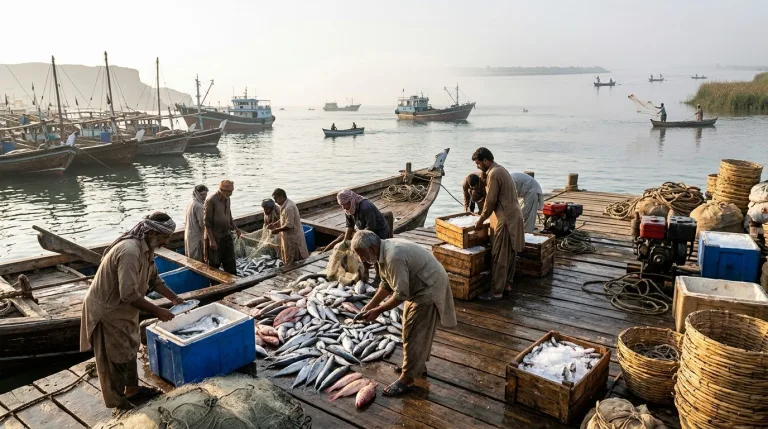
The coastline stretching from Karachi through Balochistan is the engine of Pakistan’s marine fishing industry. Karachi alone is home to one of the busiest fish harbors in South Asia, where hundreds of fishing boats unload their catch every single day. The city’s fish harbor processes thousands of tonnes of seafood annually, supplying local markets as well as packing facilities that prepare fish and shrimp for international export.
The most commercially important marine species caught in Pakistani waters include pomfret, shrimp, tuna, sardines, and cuttlefish. Pomfret is particularly beloved in Pakistani coastal cuisine, whether fried whole or cooked in a masala gravy. Shrimp is the single most valuable export product in Pakistan’s seafood trade, fetching high prices in international markets and generating significant foreign exchange for the country. The Makran coast of Balochistan, though less developed than Karachi, is home to fishing communities that have practiced traditional artisanal fishing, which means small-scale fishing using simple boats and gear, for generations.
Inland Fishing: Rivers, Lakes, and Canals
Move inland from the coast and you enter a completely different fishing world. Pakistan’s river system, built around the mighty Indus and its tributaries like the Chenab, Jhelum, Ravi, and Sutlej, is one of the most extensive in Asia. These rivers have historically been rich with freshwater fish, providing protein and income for communities along their banks long before modern fishing practices existed.
The largest freshwater reservoirs in the country, including Tarbela Dam in Khyber Pakhtunkhwa and Mangla Dam in Azad Kashmir, are also major fishing zones. Fishermen on these reservoirs use nets and longlines to catch species like rohu and common carp, which are then sold fresh in nearby markets. In Sindh, the famous Keenjhar Lake and Manchar Lake, one of the largest freshwater lakes in Asia, support large fishing communities whose entire way of life revolves around the water.
The Fish That Pakistanis Love Most
Ask any Pakistani about their favorite fish, and rohu will almost certainly be near the top of the list. Rohu is a large freshwater carp native to the rivers of South Asia, and it’s the most widely consumed fish in Pakistan’s inland regions. It has firm, white flesh, relatively few bones compared to smaller species, and a mild flavor that works beautifully with the spices commonly used in Pakistani cooking.
Catla is another hugely popular freshwater species, often raised alongside rohu in fish farms because the two breeds naturally occupy different feeding zones in the water, making them ideal tank mates. On the marine side, hilsa, a silver-colored fish with a rich, oily flavor, is especially prized in Sindh and among communities with roots in Bengal. Mahseer, a powerful river fish found in the fast-flowing streams of northern Pakistan, is famous among sport fishermen and is considered a trophy catch due to its size and fighting strength.
Fish Farming: How Pakistan Is Growing Fish on Land
Wild-caught fish from rivers and seas is only part of the story. Aquaculture, which is the practice of farming fish in controlled ponds or tanks, has grown enormously in Pakistan over the past two decades. Punjab is the leading province for fish farming, with thousands of private ponds producing rohu, catla, tilapia, and grass carp for local markets.
Fish farming appeals to farmers because it makes efficient use of land and water, and the turnaround from fingerling, which is a young fish, to market-ready size can be as short as six to eight months with the right feeding and management. Tilapia has emerged as a particularly popular farmed species in recent years because it grows quickly, tolerates a range of water conditions, and has solid market demand. The government has also invested in training programs and subsidized inputs to encourage more small and medium farmers to add fish ponds to their existing agricultural operations.
Why Fishing Matters So Much to Pakistan’s Economy
Pakistan’s fishing sector contributes billions of rupees to the national economy each year and provides direct employment to well over half a million people, including fishermen, boat crew, processing plant workers, and traders. When you include the indirect jobs created in transport, ice manufacturing, packaging, and retail, the number of people whose incomes depend on fishing is far larger still.
On a food security level, fish is one of the most affordable and nutritious sources of protein available to ordinary Pakistani families. As the country’s population grows and pressure on agricultural land increases, expanding and improving the fishing sector, both marine and inland, becomes increasingly important. Investments in better boats, cold storage infrastructure, and sustainable fishing practices are key to ensuring that Pakistan’s fish resources continue to support communities for generations to come.
Want to explore more about Pakistan’s agricultural and food industries, from livestock to fisheries? Visit Multanfarms.com for in-depth insights rooted in the farming traditions of South Punjab.