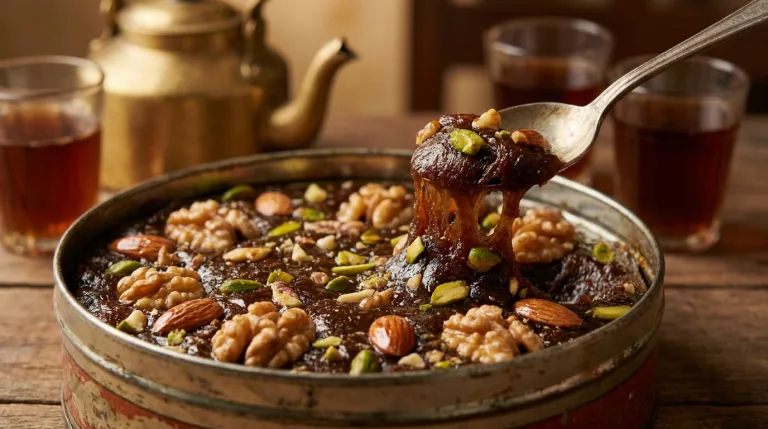
If you’ve ever visited Multan or received a gift box from someone who has, there’s a good chance a golden, brittle disc of Sohan Halva was at the center of it. This confection has been representing Multan’s sweet-making tradition for centuries, and its reputation stretches far beyond Pakistan’s borders. People carry it as gifts on international flights, order it for weddings, and argue passionately about which shop makes the best batch. So what exactly is Sohan Halva, and what makes it so special?
Sohan Halva is a dense, fudge-like sweet made from wheat germ, sugar, milk, and ghee, then studded with pistachios and almonds. Unlike most sweets that melt softly on the tongue, Sohan Halva has a firm, slightly chewy texture with a satisfying crunch from the nuts pressed into its surface. It comes in a flat disc shape, often wrapped in foil and packed in decorative boxes, making it one of the most recognizable sweets in all of South Asia.
This guide covers everything you’d want to know about Sohan Halva, from where it came from and how it’s made, to why Multan’s version is considered the gold standard.
A Sweet with Centuries of History
The story of Sohan Halva in Multan goes back hundreds of years, deeply connected to the city’s identity as a center of trade and culture along the ancient Silk Road. Multan sat at the crossroads of routes connecting Central Asia, Persia, and the Indian subcontinent, which meant merchants, travelers, and rulers passed through constantly. The city’s halva makers developed a sweet that was calorie-dense, long-lasting, and impressive enough to serve as a gift, and Sohan Halva fit all three requirements perfectly.
The name “Sohan” is believed to derive from the Persian word for a type of sweet, and the Persian influence on Multan’s food culture is visible throughout its culinary traditions. Over generations, Multani halva makers, known locally as halwais, refined the recipe to the point where the craft became a family art form. Many of the city’s most respected halva shops today are run by families who have been in the business for four or five generations.
What Goes Into Sohan Halva?
The ingredient list for Sohan Halva is short, but the quality of each component matters enormously. The primary ingredients are:
- Wheat germ, which forms the structural base of the halva
- Pure sugar, often combined with a small amount of glucose syrup
- Full-fat milk or khoya (reduced milk solids)
- Desi ghee, which gives the halva its rich, buttery depth
- Pistachios and almonds, pressed into the top for texture and visual appeal
- Cardamom, added for fragrance and flavour
- Occasionally saffron, which lends a golden colour and a delicate floral note
The wheat germ is what separates Sohan Halva from other confections. It provides a subtle nuttiness and a slightly chewy texture that no other grain quite replicates. When combined with ghee and sugar cooked to the right temperature, it produces a sweet that’s rich without being cloyingly soft.
The Making of Sohan Halva: A Craft That Takes Real Skill
Making Sohan Halva is not a casual kitchen activity. Professional halva makers cook large batches in heavy iron or copper vessels called karahi, stirring continuously over high heat for hours. The sugar syrup must reach a precise cooking stage, too early and the halva won’t set properly, too late and it becomes brittle and loses its characteristic chew.
Once the mixture reaches the right consistency, it’s poured onto a greased flat surface and spread into rounds before it cools. The nuts are pressed in immediately while the surface is still soft enough to hold them. The timing at each stage requires experience that takes years to develop, which is why Sohan Halva made by a master halwai tastes noticeably different from homemade attempts.
Temperature and humidity also play a role in how the halva sets, which is part of why Multan’s climate and the long experience of its makers produce a result that’s difficult to replicate anywhere else.
Why Multan’s Sohan Halva Is in a Category of Its Own
People from Lahore, Karachi, and even overseas Pakistani communities will tell you that Sohan Halva from Multan simply tastes different from versions made elsewhere. Part of this comes down to the quality of local ghee and the freshness of locally sourced wheat germ. Multan has a strong tradition of using high-quality desi ghee from local farms, and that fat carries most of the flavour in any halva recipe.
The city’s halwais also maintain closely guarded family recipes that include specific ratios and cooking techniques passed down through generations. Some shops slow-cook their batches over a low flame for longer periods to develop a deeper caramelised flavour. Others add a small amount of coconut or additional dry fruit to create a signature variation that distinguishes their product from every other shop on the street.
The Varieties Worth Knowing About
While the traditional plain version with pistachios is the most iconic, Sohan Halva comes in several variations today:
- Anardana Sohan Halva: topped with dried pomegranate seeds for a tart contrast against the sweetness
- Coconut Sohan Halva: mixed with shredded coconut for a chewier, more textured bite
- Kesar Sohan Halva: deeply golden in colour with a floral, aromatic depth from saffron
- Mixed Dry Fruit Sohan Halva: loaded with cashews, almonds, and pistachios for a premium version
Each variation has its loyal following, and many families have a favourite variety they order exclusively for weddings and special occasions.
How to Store and Enjoy Sohan Halva the Right Way
Sohan Halva keeps well at room temperature for two to three weeks when stored in a cool, dry place away from direct sunlight. Avoid refrigerating it, as the cold can cause the ghee to separate and alter the texture. If you’re gifting it, keep it in its original foil wrapper until it’s ready to be served.
Sohan Halva is best enjoyed in small pieces alongside a cup of strong doodh patti chai. The sweetness of the halva balances beautifully against the bitterness of a well-brewed tea, and this pairing has been a part of Multani hospitality for generations. It’s a sweet meant to be shared, served to guests, and given as a gesture of genuine warmth.
The Sweet That Carries a City’s Identity
Sohan Halva is more than a confection. It’s a piece of Multan’s cultural identity, a link between the city’s storied past and its present, and a gift that carries meaning wherever it travels. Every disc holds the craft of generations of skilled halwais who dedicated their lives to getting it exactly right.
If you want to experience genuine Multani Sohan Halva made the traditional way, visit Multanfarms.com and bring a taste of Multan’s heritage straight to your table.